

Gartner research projects that by 2028, roughly 1 in 4 job candidates worldwide could be fake, built from stolen identities and AI-generated profiles. That number should stop every hiring leader mid-scroll. It is not about a padded job title anymore. It is about whether the person on the video call is even real. And for companies that have already lived through the toxic fallout of a bad hiring mistake, the question is not whether this can happen to them. It is whether it already has.
This guide breaks down how resumes lie in 2026, why the tools built to filter candidates were never built to catch liars, and what recruiters, staffing firms, and TA teams need to do differently before another bad hire slips through.
How Resumes Lie in the Age of AI
Resume embellishment used to mean rounding up a GPA or inflating a job title. That version of the problem still exists, but it is no longer the biggest threat. AI has changed the mechanics of resume fraud entirely.
Generative tools can now produce a polished, keyword-optimized resume in seconds. They can fabricate work history that reads as plausible rather than exaggerated. an fabricate work history that reads as plausible rather than exaggerated. When AI writes the resume, what is left for recruiters to trust is a question the industry is only beginning to wrestle with honestly. Generative tools can produce cover letters tailored to a specific job posting, complete with invented achievements that sound exactly like what a hiring manager wants to hear. Some candidates use AI during live video interviews to feed them answers in real time. Others use deepfake or AI-altered photos to disguise who is actually applying. Your recruiters are being catfished by pretty PDFs every day, and most hiring processes have no mechanism to catch it.
This is candidate fraud, not casual resume misrepresentation. The distinction matters. A recruiter can forgive someone who stretched a job title. A recruiter cannot afford to onboard someone who does not exist, or who is not who they claim to be.
Anyone building a resume verification guide for 2026 has to start from this reality: the fraud is deliberate, scalable, and getting harder to spot with the naked eye. For a deeper look at how far this has gone, this piece on resumes lying more than ever in the AI era lays out the shift in detail.
Why ATS Was Never Built to Catch Liars
Every applicant tracking system (ATS) on the market does one job well: it filters and ranks resumes by keywords. That is what it was designed for. It was never designed to verify a candidate’s identity, confirm their employment history, or check whether a credential is real. AI promised to save recruiting, and for volume and speed, it delivered. For scrutiny, it did not.
This is not a vendor failure. It is a structural gap. ATS platforms scan for pattern matches against a job description. A fabricated resume with the right keywords will sail through an ATS just as easily as a genuine one, sometimes more easily, because AI-written resumes are often optimized specifically to beat keyword filters. Saying a candidate seems great is not a strategy, and a keyword match is even less of one. Your hiring team needs forensic proof, not a formatting score.
That gap is exactly where resume fraud in hiring slips through. By the time a recruiter reviews a shortlist, the fraud has already cleared the first screen undetected. Catching it later, during reference checks or background screening, means the damage is already partly done: hours spent interviewing, a role held open, a hiring manager’s time burned on someone who was never qualified.
Josh Bersin, the well-known HR industry analyst and CEO of The Josh Bersin Company, has pointed out that as AI reshapes talent acquisition, verifiable candidate data becomes one of the most important assets a hiring team can have. Trust in the pipeline, in his view, has to be earned through evidence, not assumed from a well-formatted resume.
The North Korea Wake-Up Call
The stakes go well beyond one exaggerated resume. Since 2024, the US Department of Justice and FBI have disclosed and prosecuted multiple schemes in which North Korean IT operatives used stolen or fabricated American identities, in some cases paired with AI-altered photos, to land remote software engineering and IT contractor roles at US companies.
Wages from those jobs were funneled back to the North Korean regime. AI has made resume fraud by industry dramatically worse, and the sectors being hit hardest are not always the ones with the strongest verification controls.
Security awareness company KnowBe4 publicly disclosed in 2024 that it had unknowingly hired one such operative. The candidate passed a background check and a video interview using a stolen identity, and only unusual activity on a company laptop gave the deception away.
If a company built specifically to train employees on security threats can be fooled, no organization should assume its own process is immune. For staffing firms, the exposure compounds further: one fake degree, one bad placement, and one lost client is all it takes to undo years of a hard-built reputation.
Top 5 Ways AI Makes Resume Fraud Easier Than Ever
- Instant resume generation
AI tools produce a fully formatted, keyword-matched resume in under a minute, complete with fabricated job titles and achievements.
- Synthetic work history
Generative models invent plausible-sounding employers, dates, and responsibilities that are difficult to distinguish from real experience without direct verification.
- AI-assisted interview coaching
Some candidates use real-time AI prompts during video interviews to answer technical questions they could not answer unaided.
- Deepfake or altered identity
AI-edited photos and, in rarer cases, voice or video manipulation let one person apply, interview, and work under someone else’s identity.
- Credential and certificate fabrication
AI-generated documents can mimic diplomas, licenses, and certification badges closely enough to pass a quick visual check.
Each of these tactics shares one thing in common: none of them get caught by a keyword filter. Candidate fraud examples like these only get caught by verification that happens before the resume reaches a hiring manager’s inbox.
What the Data Says About Resume Deception
Industry surveys have long found that a large majority of job seekers, commonly cited above 70 percent across multiple studies from firms like HireRight, CareerBuilder, ResumeLab, and StandOutCV, admit to lying or exaggerating somewhere on a resume. All resumes lie, but resume inflation has turned it into an art form with techniques that have evolved far beyond the padded GPA. The same body of research has consistently found that a meaningful share of formal background checks, commonly cited in the 20-30% range, turn up a discrepancy against what the candidate originally claimed.
Those numbers predate the AI acceleration described above. Given how much easier fabrication has become, there is little reason to expect the trend to reverse on its own.
How to Detect Resume Fraud Before It Costs a Company
Knowing how resumes lie is only half the equation. The other half is knowing how to detect resume fraud early enough for it to matter. That means checking employment history against verifiable sources, confirming credentials directly with issuing institutions, and flagging timeline inconsistencies before an interview is ever scheduled. Is your recruiter accidentally burning through budget every time they trust a polished resume that turns out to be fiction is a question worth running through your actual cost-per-hire numbers.
Recruiters trained to spot trouble early can catch a surprising amount before a candidate ever gets on a call. This breakdown of resume red flags recruiters must catch before the first call costs them a client walks through the specific signals worth watching for.
Even experienced teams make process mistakes that let fraud through anyway, often around how verification is sequenced or who owns it.
Where Verification Has to Happen
The core problem is timing. Most verification today happens after a candidate has already been shortlisted, sometimes after an offer has already gone out. By then, a fabricated identity or invented work history has already consumed real time and resources. Your recruiting team is not a group of data entry clerks, and burying them in manual verification that should have happened at the door is exactly how their capacity gets hollowed out while fraud still slips through.
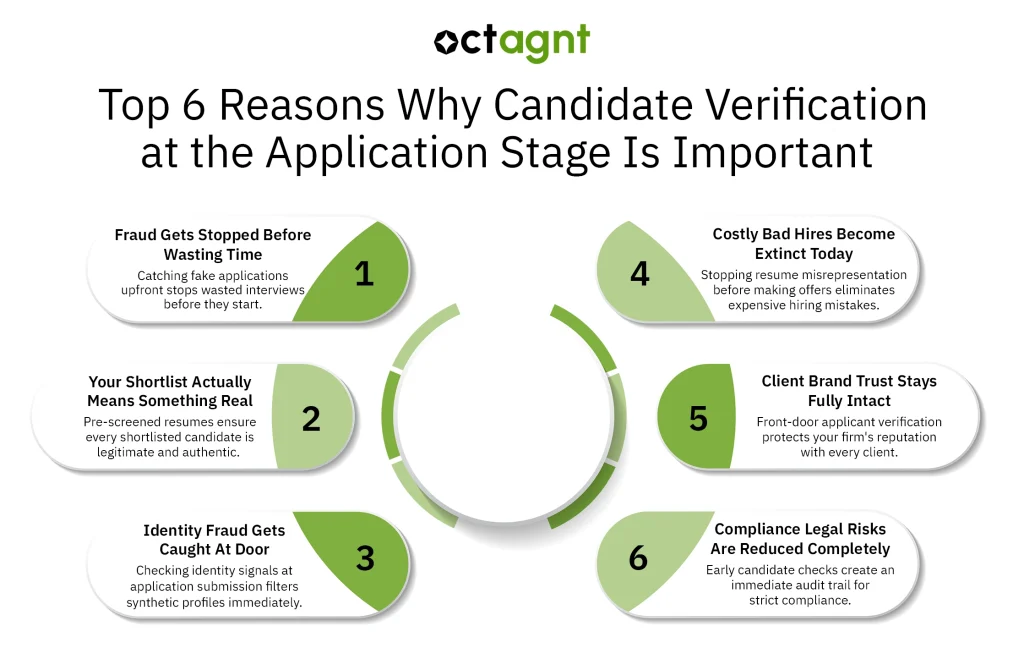
Catching resume fraud has to happen at the application stage, before the ATS ever touches the resume. That is the only point in the process where fraud can be filtered out without wasting a recruiter’s time on someone who should never have made the list. Can your recruiting team survive the fallout of the last hiring mistake is a harder question to answer once the damage is already done.
AI-driven verification at the front door means the shortlist a hiring manager sees is already vetted, not just keyword-matched. This piece on building shortlists that are fast, verified, and reasoned explains what that looks like in practice, and this one on AI catching a lying candidate before the recruiter does shows the mechanics behind it.
Staffing agencies face this pressure most acutely, since they are placing candidates into other companies’ payrolls and reputations. Employment gaps deserve their own scrutiny too, since a real gap and a fabricated one can look identical on paper.
Key Takeaways
- Gartner research projects up to 1 in 4 global candidates could be fake by 2028, driven by identity fraud and AI-generated profiles.
- ATS technology filters resumes by keyword. It was never built to verify identity, employment history, or credentials, and that gap is structural.
- Industry surveys have long found that most job seekers admit to resume embellishment, and a meaningful share of background checks confirm it.
- Resume fraud in hiring has to be caught at the application stage, before a resume ever reaches an ATS or a hiring manager.
Final Thoughts
Resume fraud is not slowing down, and neither should the response to it. Verification that happens before the ATS, not after the interview, is the only way to stay ahead of it.
The tools that built modern hiring were never designed for the threat environment that now exists. Keyword filters, video interviews, and even traditional background checks all have well-documented gaps that deliberate, AI-assisted fraud is built to exploit. The fix is not a longer interview process or a more expensive background check ordered a week before onboarding.
The fix is catching fabricated identities, invented credentials, and synthetic work histories at the moment an application arrives, so that every interaction that follows is grounded in verified reality rather than assumed good faith. That is the standard hiring needs to move toward, and the technology to do it at scale already exists. See what that looks like firsthand and Try for Free.
Frequently Asked Questions (FAQs)
- Should recruiters worry about resume fraud more in 2026 than in past years?
Yes, AI tools now generate fabricated resumes and identities faster and convincingly, making resume fraud harder for recruiters to catch.
- Can hiring managers rely on ATS software alone to detect resume misrepresentation?
No, ATS software filters resumes by keyword only and was never designed to detect resume misrepresentation or verify candidate identity.
- Do talent acquisition teams need new tools to catch candidate fraud today?
Yes, talent acquisition teams need strong verification tools that check identity and history before candidate fraud reaches the interview stage.
- Is resume embellishment still common among job seekers applying for roles?
Yes, industry surveys have long found that most job seekers openly admit to resume embellishment somewhere on their application materials.
- Should hiring managers assume background checks alone will catch fake resumes?
No, background checks catch some fake resumes, but a meaningful share of discrepancies still slip through completely undetected during hiring.
- Can recruiters spot resume fraud before scheduling an interview with a candidate?
Yes, recruiters trained on specific red flags can spot signs of resume fraud before ever formally scheduling an interview call.
- Is identity fraud a realistic concern for TA specialists hiring remote workers?
Yes, TA specialists hiring remote roles should treat identity fraud as a real risk, given documented cases involving stolen identities.
- Do staffing agencies face higher exposure to candidate fraud than internal teams?
Yes, staffing agencies face higher exposure to candidate fraud since they place candidates directly into other client companies and payrolls.