

On a Tuesday morning, a mid-sized North American tech enterprise finalized the remote hire of a senior cloud architect. The candidate had smashed through four rounds of video interviews. His resume was a masterpiece of specialized enterprise achievements. He cleared a standard background check with zero red flags. He onboarding seamlessly, and the team shipped a high-end corporate laptop to his verified Florida address.
By Friday afternoon, the company security operation center flagged a massive, unauthorized data exfiltration event. The corporate laptop was not in Florida. It was sitting inside a covert, state-sponsored “laptop farm” in the Midwest, controlled via remote access software by an operative working directly for North Korean state intelligence. The elite tech architect did not exist.
The entire persona, from the impeccable corporate history to the flawless interview responses, was the most sophisticated form of resume fraud the hiring team had never been trained to spot. A synthetic identity, built entirely by generative AI, had walked straight through a process designed to catch exactly this.
This is not a hypothetical sci-fi scenario. According to a 2026 Department of Justice investigation and FBI updates, hundreds of North American organizations have inadvertently hired rogue state-sponsored agents. The threat actor simply reverse-engineered the company job descriptions using AI, generated hyper-optimized resumes, and deployed real-time deepfake audio and video feeds to effortlessly sail through online interviews.
For executive teams, HR executives, and staffing firms across North America, the traditional hiring model is officially broken. The baseline trust that used to protect the talent acquisition funnel has dissolved.
The Scale of Resume Fraud Nobody Wants to Talk About
Here is the number that should be on every staffing firm’s wall.
According to HireRight’s 2025 Employment Screening Benchmark Report, discrepancies were found in nearly 40% of background checks conducted across North American employers. SHRM’s 2025 Talent Acquisition Benchmarking data puts it differently: 85% of HR professionals say they have personally caught a candidate lying on a resume.
That is a systemic fraud problem.
Resume lies in recruiting are not edge cases. They are embedded in the pipeline at a scale most hiring teams are not equipped to address. Forbes reported in 2025 that resume fraud contributes to an estimated $600 billion in annual U.S. business losses when factoring in bad hire costs, lost productivity, and re-recruitment spend. And that number understates the real damage, because it doesn’t account for client attrition when a staffing firm delivers a misrepresented candidate.
Gartner predicts that by 2028, 1 in 4 candidate profiles could be fake. That is not a distant warning. It is a trajectory already visible in the fraud volumes hiring teams are dealing with today.
Josh Bersin, one of the most widely cited voices in HR research, has described the current environment as a “skills trust gap” where organizations have no reliable mechanism for validating whether what a candidate claims reflects what they can actually do. That gap is widening, not closing.
AI Has Made Resume Fraud Faster, Cleaner, and Harder to Catch
This is where the 2025 version of this problem diverges sharply from anything that came before it.
Generative AI tools have completely democratized resume fraud. A candidate who once would have struggled to format a convincing fabrication can now produce a polished, keyword-optimized, role-specific resume in under ten minutes. The output reads like a real document because, structurally, it is one.
Hung Lee, founder of Recruiting Brainfood and one of the most followed analysts in the global recruiting industry, flagged this in early 2025. He pointed out that the proliferation of AI-assisted applications had made it nearly impossible to distinguish a genuine candidate from an AI-optimized version of a fraudulent one, using the tools most recruiting teams currently have.
Here is what AI enables that wasn’t previously possible at scale:
- Keyword precision: AI matches resume language to job descriptions with surgical accuracy. The result clears ATS filters that were designed for legitimate candidates.
- Fabricated achievements: AI generates specific, quantified accomplishments that sound real because they follow the exact format of real ones. “Reduced client churn by 23% through implementing X” is easy to generate. It’s hard to disprove without verification.
- Identity layering: AI helps construct consistent personas across online career portals, personal websites, GitHub profiles, and application documents. The entire digital footprint looks legitimate.
Volume fraud: A single candidate can run dozens of simultaneous applications with slightly different resume versions, optimized for each role, without any manual effort.
The ATS platforms and first-round screening processes most recruiting teams rely on were built to organize applicants, not detect resume fraud. They were designed to sort candidates based on relevance, keywords, and experience claims. They were never designed to verify whether those claims are true. As AI-generated resumes become more sophisticated, resume fraud performs better in systems that reward optimization over validation and keywords over credentials.
When a recruiter can’t determine what on a resume is actually trustworthy, every candidate submitted carries hidden risk. And the irony runs deeper: the same AI tools that were supposed to make recruiting faster are now shielding fraud better than any human candidate ever could. Many recruiting teams are starting to realize that automation made their workflows leaner but left them more exposed than before.
Top 5 Resume Lies That Slip Through Every Single Day
This is the section that will surprise you: the most common forms of resume fraud are not sophisticated. They survive because hiring processes rarely check them.
1. Inflated Job Titles
A coordinator becomes a manager. A junior developer becomes a lead engineer. The title inflation is typically paired with fabricated responsibilities and achievements that match the elevated role. It’s the most common form of resume fraud and one of the easiest to verify, if anyone bothers.
2. Stretched Employment Dates
Gaps are stigmatized. So candidates close them. A termination in March becomes an end date in September. A gap year gets quietly buried. A few months of misrepresentation can hide a firing, a performance improvement plan, or a legal issue.
3. Unearned Educational Credentials
This ranges from listing a degree from a school attended but not graduated from, to claiming an advanced degree that was never pursued. Certifications are listed as active when they lapsed years ago. Professional licenses are claimed at levels never attained.
4. Fabricated Technical Skills
Especially common in tech, healthcare, and finance roles. Candidates list proficiency in platforms, tools, or systems they have minimal or no real experience with. This is the lie most likely to surface after the hire. By then, the cost is already locked in.
5. Staged References
Coached references. Friends playing former managers. Actual former colleagues briefed on what to say. Without verifying who the reference is, what their actual relationship was, and whether their account matches employment records, a reference check tells you almost nothing useful.
These five categories account for the vast majority of resume fraud in recruiting. They are predictable. They are detectable. And yet they are still catching hiring teams off guard because verification is treated as a final step rather than a core workflow.
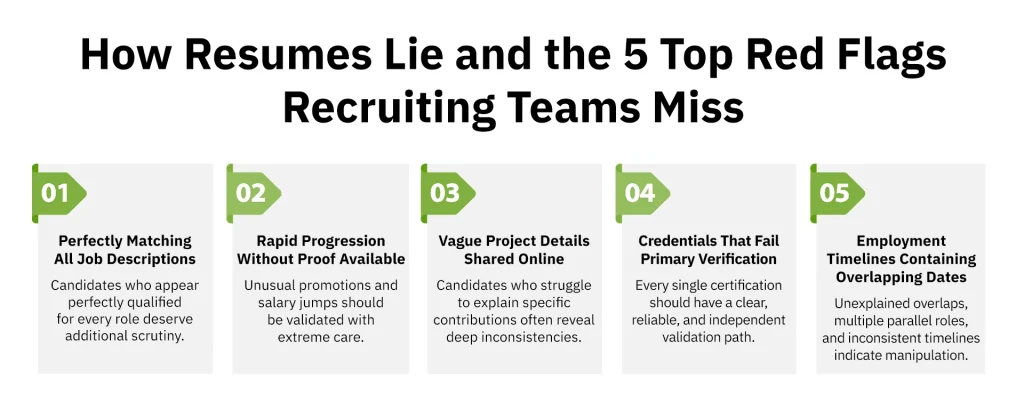
How Resume Fraud in Recruiting Slip Through the Cracks
Most hiring processes were not designed for the fraud environment that now exists.
A recruiter receives 200 applications. The ATS filters for keywords. The top 20 go to a human reviewer. That human reads summaries, not full documents, under time pressure. Phone screens focus on personality and fit. Technical assessments, when they exist, are brief. References get a five-minute scripted call. An offer goes out.
At no point does anyone systematically confirm whether the employment history is accurate, whether the degree exists, whether certifications are current, or whether the references are who they say they are.
Part of the problem is presentation itself. A clean layout, confident language, and tight formatting signal competence to the human brain before a single fact is checked. Recruiters aren’t weak for falling for it — they’re responding exactly the way a polished document is designed to make them respond. A well-formatted lie looks identical to a well-formatted truth.
Speed makes it worse. When the client wants a shortlist in 48 hours, verification gets treated as a nice-to-have. That trade-off has a real price tag. Per SHRM’s 2025 data, replacing a misrepresented hire costs between 30% and 213% of that position’s annual salary depending on seniority. Speed that skips verification is not efficiency. It’s deferred cost.
And there’s a human side to this that staffing leaders rarely discuss. When a fraudulent placement blows up, the fee refund is the visible damage. What’s harder to see is what it does to the recruiting team that made the call. The recruiter carries that. The team carries that. It doesn’t disappear when the invoice is reversed.
The answer to resume fraud is not better instinct. It’s structured, documented evidence collected before the shortlist goes to the client.
Candidate verification software integrates into the screening workflow rather than sitting at the end of the process as a final background check. The difference matters. When verification happens early, fraudulent candidates are removed before time, interviewer hours, and client attention are spent on them.
What effective candidate verification software does:
- Confirms employment history against verifiable sources, not just candidate-provided references
- Validates educational credentials directly with issuing institutions
- Checks certification and license currency with the bodies that issued them
- Flags inconsistencies between application versions, online career portals, and employment records
- Generates a documented audit trail for every candidate on every shortlist
That last point is not administrative overhead. For staffing firms, a verified audit trail is a business protection asset. When a client questions a placement, the difference between defending the firm’s process and refunding the fee is whether verification was documented or just assumed.
That audit trail also changes the client conversation entirely. When every shortlisted candidate comes with a verified, documented case for why they belong on the list, the firm stops defending placements and starts leading them.
And for recruiting leaders worried their teams don’t have the bandwidth: verification infrastructure doesn’t add work, it removes it. Fraudulent candidates caught early don’t make it to interview prep, client calls, or offer negotiation. Recruiters freed from chasing bad leads have more time for the work that actually moves a role forward not less.
What the Best Staffing Agencies Do Differently
The staffing firms building durable client relationships in 2025 share one operating principle: they deliver evidence, not just candidates.
In an era where resume fraud is becoming harder to spot and easier to scale, trust alone is no longer a hiring strategy. Every shortlisted candidate comes with a verification summary. Claim is cross-referenced. Every discrepancy is disclosed before the client interview begins. The recruiter’s instinct still matters, but it is supported by documented proof, not replaced by it.
Hung Lee has described this transition as a move from confidence-based hiring to evidence-based hiring. It is not a philosophical preference. In the current fraud environment, it is the only approach that holds up when a client asks hard questions.
Any staffing leader still relying on recruiter instinct as the primary quality control mechanism should reckon with a hard truth: feeling good about a candidate is not the same as having proof they are who they claim to be. The two feel identical in the moment. They produce very different outcomes.
For leaders who need to make this case to a CFO or a board, the numbers do the work. Every unverified placement is a financial bet with no downside protection — and when it goes wrong, the loss rarely shows up on a single line item.
Hiring intelligence is what separates firms that place candidates from firms that place the right candidates. That distinction is the entire business model.
Key Takeaways
- Resume fraud affects nearly 40% of all background checks run in North America, per HireRight’s 2025 benchmark data
- Generative AI has made fraudulent resumes cheaper, faster, and nearly indistinguishable from legitimate ones
- State-sponsored actors, including North Korean operatives, have successfully infiltrated U.S. companies through fabricated identities
- The top five faked credentials follow a predictable pattern that candidate verification software can flag systematically
- Evidence-based hiring, not recruiter instinct, is the only reliable defense in today’s fraud environment
- Staffing firms that verify before submitting build the client trust that volume-based firms consistently lose
Final Thoughts
Resume fraud is not going away. AI has made it faster, cheaper, and more convincing than any previous iteration. State-sponsored actors have demonstrated it can be weaponized at scale. And most recruiting workflows in North America were built for a world where candidates were, by default, telling the truth.
That world no longer exists.
The staffing agencies and HR teams that thrive in this environment are the ones that stop treating candidate claims as facts and start treating them as hypotheses that need testing. Hiring intelligence is not a premium add-on. It is the foundation of a placement that holds up.
Verification is not distrust. It is due diligence. And for the clients who rely on recruiting firms to make good hiring decisions, it is what professional service actually looks like.
See what forensic, evidence-based recruiting looks like on a real role. Try One Role for Free
Frequently Asked Questions (FAQs)
Q1. Can a staffing agency lose a client contract over a single fraudulent placement?
Yes. Most enterprise service agreements include misrepresentation clauses. One unverified bad hire can trigger fee clawbacks, account suspension, and permanent client loss.
Q2. Should recruiters trust a candidate’s online career profile as a secondary verification source?
No. AI tools now generate consistent, cross-platform personas. Online career profiles can be fabricated just as convincingly as a resume.
Q3. Is a phone-based reference check sufficient for a TA specialist to confirm a candidate’s employment history?
No. References can be coached, staged, or entirely fictitious. Confirming the reference’s actual identity and relationship is essential before any information is relied upon.
Q4. Can hiring managers spot AI-generated synthetic candidate personas during a video interview?
No. Deepfake audio and video tools now operate in real time. A confident, fluent video interview no longer confirms the person is who they claim to be.
Q5. Should staffing agencies integrate credential verification before submitting a shortlist to a client?
Yes. Early-stage verification removes fraudulent candidates before client time and resources are invested, and creates a defensible audit trail for every placement.
Q6. Do fabricated technical skills typically surface during the interview stage or after the hire?
No, rarely during interviews. Skill fabrications most often surface post-hire, once the candidate is expected to perform independently on real deliverables.
Q7. Can a TA specialist rely on an ATS to flag inconsistencies in a candidate’s application history?
No. ATS platforms are built to rank keyword relevance, not verify factual accuracy. Fraud detection requires a separate, dedicated verification layer.
Q8. Is resume fraud a bigger legal risk for staffing firms operating in regulated sectors like healthcare or finance?Yes. Licensing and compliance obligations mean a fabricated credential isn’t just a bad hire. It can constitute a regulatory breach with direct legal consequences for the firm.
Q9. Should hiring managers request documented verification from their staffing partner before approving interviews?
Yes. A verified candidate summary protects interview time, reduces downstream risk, and gives the hiring manager a factual basis for the final decision.
Q10. Can a recruiting team realistically detect state-sponsored synthetic identities using standard hiring tools?
No. Operatives using AI-generated profiles and coordinated support are specifically designed to pass conventional screening. Specialized candidate verification software is the only reliable countermeasure.