

Imagine handing a recruiter $100,000 in cash and telling them to trust their gut. That is, effectively, what happens every time a hiring decision rests on vibes, résumé polish, and a firm handshake. The candidate “seemed like a great fit.” They were “easy to talk to.” They had “fantastic energy.” Six months later, they are gone or worse, still there, quietly corroding your team from the inside.
This is not hypothetical. It is a systemic, measurable crisis playing out across boardrooms and HR departments right now. And the numbers in 2025–2026 make it impossible to look away.
The True Cost of a Bad Hire: The Numbers You Cannot Afford to Ignore
Most hiring managers think a bad hire costs them a few weeks of lost productivity. They are off by an order of magnitude.
$5,475
Average cost-per-hire for non-executive roles in 2025
SHRM / Forbes, 2025
$35K+
Average cost-per-hire for executive positions
SHRM / Forbes, 2025
200%
Of annual salary to replace a bad executive hire
INOP / U.S. Dept. of Labor, 2026
17%
Of manager time consumed by underperformers
Gartner via Tawzef, 2026
According to SHRM and Forbes, the average cost-per-hire in 2025 climbed to $5,475 for non-executive roles and surpassed $35,000 for executives. But that is only the entry fee. The INOP 2026 Report, citing both the U.S. Department of Labor and SHRM research, confirms what talent strategists call the “30% Rule”: a bad hire typically costs at least 30% of that employee’s first-year salary. For senior leaders, the “Executive Multiplier” takes over: replacing a mis-hired executive can consume up to 200% of their annual compensation when you account for recruitment, onboarding, severance, lost client relationships, and team disruption.
The drain does not stop at the exit interview. Gartner’s 2026 research reveals that managers spend up to 17% of their working hours managing underperformers. That is nearly one full day per week consumed not by strategy, innovation, or growth, but by damage control.
The "Nice Guy" Bias: How Likability Hijacks the Hiring Process
When "Great Culture Fit" Is a Red Flag
Recruiters often fall into the trap of confusing social lubrication with professional competence. When a candidate is charismatic, we subconsciously forgive their technical gaps. However, relying on the fact that a candidate seems great is not a strategy
in fact, it’s a recipe for expensive turnover. Without forensic proof, you aren’t hiring—you’re gambling.
The danger lies in how we justify this risk. The “nice guy” resume problem is insidious precisely because it feels responsible. Hiring for “culture fit” sounds strategic. It sounds human-centered. It sounds smart. But without a data-backed baseline, it is often none of those things.
Talent expert Josh Bersin has been sounding this alarm for years. In his framework around the “Business of Talent,” Bersin argues that cultural fit is not a feeling, it is a financial metric. When organizations define culture fit as “someone I’d grab a beer with,” they are not measuring alignment with company values, work methodology, or performance drivers. They are measuring social ease. And social ease, as the data consistently shows, has almost no predictive validity for on-the-job performance.
“Cultural fit isn’t a soft concept, it’s one of the most financially consequential decisions a company makes. But most organizations measure it with a gut check instead of a framework.”
— Josh Bersin, HR Industry Analyst & Founder, The Josh Bersin Company
The result is a hiring process that systematically over-selects for charisma and under-selects for competence. Personable candidates advance. Skilled but reserved candidates stall. And companies pay the price, literally for months or years afterward.
HR Tech Has Outpaced Hiring Practices
HR technology analyst George LaRocque has spent years documenting the widening gap between available hiring technology and actual hiring practices. His core thesis is blunt: instinct-based hiring is failing in the age of data and companies that cling to it are not being human-centered, they are being negligent.
LaRocque’s research points to a profound paradox. Organizations now have access to behavioral assessments, predictive analytics, structured interview scoring, and AI-assisted sourcing tools that dramatically improve hiring accuracy. Yet a significant share of hiring managers still rely primarily on résumé aesthetics and interview “feel” to make six-figure talent commitments.
The economic argument is unambiguous. When a $120,000-a-year manager turns out to be a mis-hire, the 30% Rule puts the floor cost at $36,000. The Executive Multiplier puts the ceiling at $240,000. Every single one of those dollars represents a decision that felt right in a conference room but was never validated by structured data.
Why Hiring Mistakes Cost More Than You Think
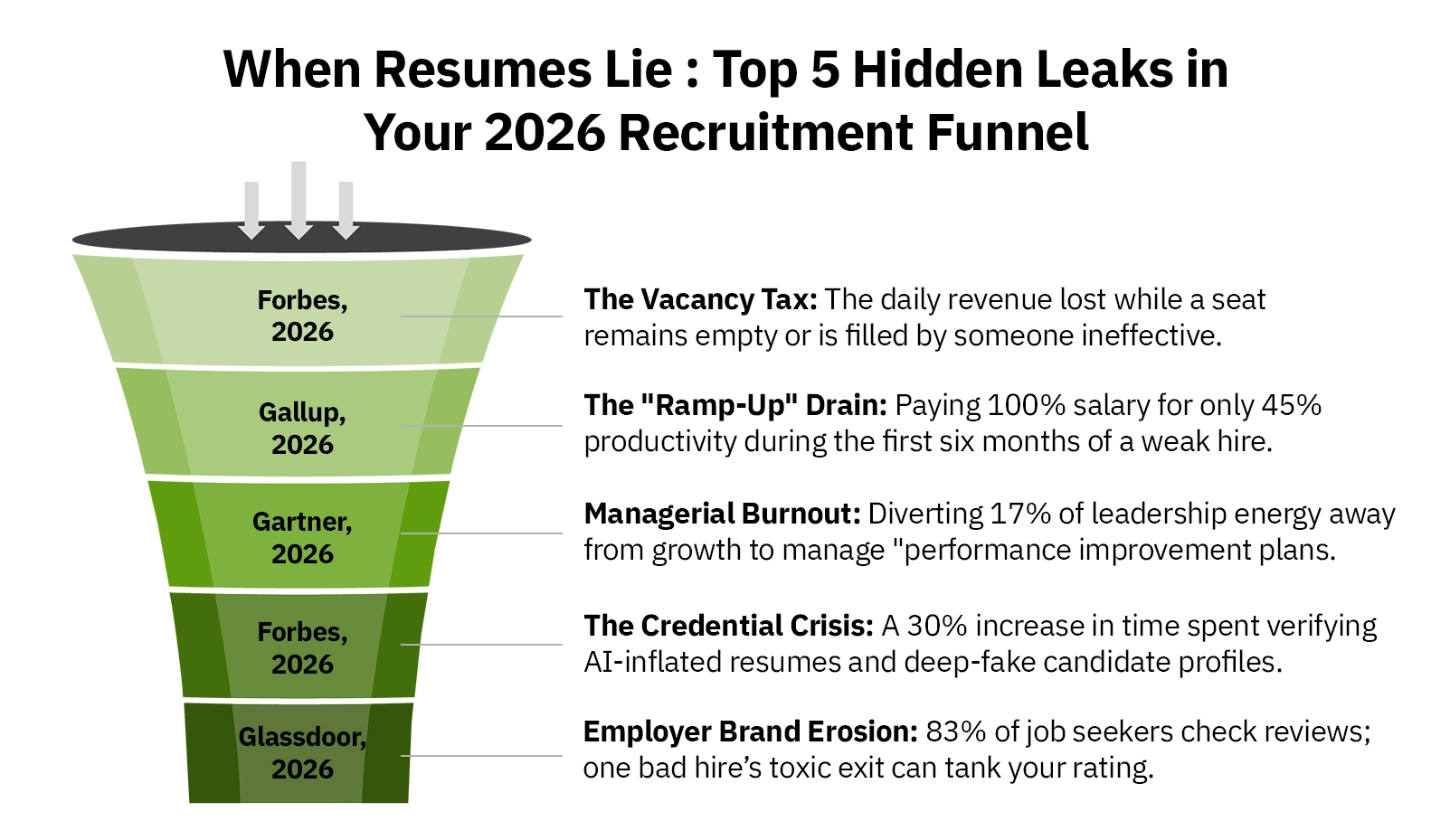
The true cost of a bad hire is an iceberg; the salary is merely the visible tip. In 2026, the financial wreckage lies beneath the surface in lost momentum and “hidden” taxes. Use these five data points to visualize your company’s recruitment leaks:
- The Vacancy Tax: Every day a role stays empty or poorly filled, you lose the daily revenue that position generates.
- The “Ramp-Up” Drain: You pay 100% salary for roughly 45% productivity during a weak hire’s six-month struggle.
- Managerial Burnout: Managers lose 17% of their week babysitting underperformers instead of driving growth.
- The Credential Crisis: Verifying AI-inflated resumes now adds 30% more time to the hiring cycle.
- Brand Erosion: 83% of candidates check reviews; one toxic exit can double your future recruitment costs by tanking your Glassdoor rating.
The Ripple Effect: How One Bad Hire Tanks an Entire Team
The financial damage of a bad hire does not stay contained to one employee’s headcount. It spreads.
Gallup’s 2026 research adds a critical dimension to this calculus: high performers are significantly more likely to disengage when poor performance is tolerated within their team. The logic is straightforward. Your best people have options. When they watch a colleague coast, miss targets, and face no accountability, they draw a clear conclusion about organizational standards, and they start updating their LinkedIn profiles.
This means that one bad hire does not just cost you the price of replacing that person. It costs you the productivity erosion of every teammate who disengages as a result. It costs you the recruitment and onboarding expense of every high performer who walks out the door. The original $100,000 problem has now become a $400,000 problem and it all traces back to a hiring decision made on likability rather than evidence.
What Rigorous Hiring Actually Looks Like in 2026
The solution is not to hire robots and eliminate human judgment from the process. It is to use human judgment where it is genuinely valuable: in assessing motivation, values alignment, and communication style, while using structured frameworks everywhere else.
Concretely, this means replacing open-ended “tell me about yourself” openers with behavioral and situational interview questions tied directly to the role’s core competencies. It means using pre-employment skills assessments for roles where technical capability is non-negotiable. It means implementing structured scoring rubrics so that every interviewer evaluates every candidate against the same criteria, rather than comparing their own subjective impressions after the fact.
It means, in short, building a hiring process that would embarrass you if you described it to a data analyst, and fixing it before a mis-hire forces you to.
Key Takeaways
- A bad hire is not just a personnel problem, it is a financial event. The true cost compounds through recruiting, onboarding, team disruption, and lost high-performer retention.
- The SHRM “30% Rule” and “Executive Multiplier” (up to 200% of annual salary) put hard dollar figures on what instinct-based hiring actually costs your organization.
- Likability and cultural fit are not the same metric. Josh Bersin frames cultural fit as a financial decision: one that demands a framework, not a gut check.
- Gartner (2026) confirms managers spend up to 17% of their time managing underperformers, nearly one full day per week diverted from strategy and growth.
- Gallup research shows that tolerating poor performers triggers disengagement in your best people. One bad hire can set off a chain reaction of departures across the whole team.
The Bottom Line: Likability Is Not a Hiring Criterion
The math is not subtle. Between the 30% Rule, the Executive Multiplier, the 17% manager-time drain, the team disengagement cascade, and the rising cost-per-hire benchmarks from SHRM, companies that continue to hire on gut feel are not just taking a risk. They are making a predictable, recurring, and entirely avoidable investment in failure.
Your next “nice guy” hire might be exactly who you think they are. Or they might cost your organization $200,000, six months of management bandwidth, and three of your best performers who got tired of carrying dead weight.
The data has been clear for years. The question is no longer whether gut-feel hiring is expensive. Question is how many more times you are willing to pay for it.
Ready to stop the burn? Try one role for free and see the difference forensic verification makes.
Frequently Asked Questions (FAQs)
- How much time do managers lose to underperforming hires?
Gartner (2026) reports that managers lose 17% of their productive hours managing “mis-hires,” diverting critical leadership energy away from revenue-generating activities. - Can a bad hire impact the retention of high-performing employees?
Yes. Gallup research shows that top performers are 3x more likely to disengage when they see recruiting teams tolerating poor performance within the team. - How is AI-generated resume inflation affecting recruiting teams?
Recruiting teams are seeing a 30% increase in verification time because candidates use AI to “perfect” their resumes, making forensic skill-checking a mandatory requirement. - How can recruiters move from instinct-based to intelligence-based hiring?
To move from instinct to intelligence, recruiters must replace “gut feelings” with forensic proof. This involves shifting from subjective interviews to skills-based assessments and data analytics that verify a candidate’s actual output. - What should be the gold standard for every candidate shortlist?
Every shortlist presented by recruiters should be fast, verified, and reasoned. Ensuring these three pillars prevents the “lighting money on fire” scenario and secures high-ROI talent. - Why do recruiters keep making bad hires even when they know the risks?
Most recruiters are not making bad hires because they are negligent they are making them because their process is built on intuition rather than evidence. Hiring for “culture fit” as a feeling, relying on likeable candidates, and using unstructured interviews all introduce affinity bias at scale. - How does a bad hire affect team performance and employee engagement?
When a recruiting team fills a role with a mis-hire, the damage does not stay contained to that person’s work output. The strongest employees who have options watch standards erode and start updating their LinkedIn profiles. The original hiring cost multiplies because companies now face turnover among people they cannot afford to lose. - What is data-driven hiring and how can recruiting teams implement it?
Data-driven hiring replaces unstructured, impression-based interviews with behavioral assessments, structured scoring rubrics, pre-employment skills tests, and data analytics: all evaluated against consistent criteria for every candidate. For recruiting teams, implementation starts with three practical changes: replacing open-ended openers with competency-anchored behavioral questions, using role-specific skills assessments, and requiring every interviewer to score candidates against the same rubric before any debrief discussion. - How can recruiting teams tell the difference between a strong candidate and a well-polished resume?
A polished resume signals presentation skill, not job performance. In Boolean sourcing, precision is the standard: you search for exact, verifiable competencies, not impressive-sounding titles. Recruiting teams can apply the same logic to their screening process by requiring candidates to demonstrate specific skills rather than describe them, validating experience through structured reference calls with direct supervisors, and using skills-based assessments tied to actual role requirements.