

The video connection was slightly grainy, but the candidate answers were spectacular. She quoted industry statistics instantly. Solved complex coding problems on the fly. She handled tough behavioral questions with poise. The staffing agency confidently placed her at a top-tier client. On day one, a completely different person showed up for work. The original applicant used a sophisticated, real-time AI face-swap filter and a synchronized voice model during the interview.
The recruitment pipeline has officially become an active corporate cyberattack vector. Industry influencer Hung Lee frequently warns that traditional vetting processes are failing. If your screening workflow relies on a pleasant conversation and a PDF, your organization is exposed. The trust that once anchored the employment relationship has vanished. It is replaced by an urgent need for absolute operational verification.
Resumes Lie and It Is No Longer a Document of Truth
For decades, the resume served as a reliable proxy for human capability. It required effort to construct. It required time to format. Today, that barrier to entry is completely gone.
A 2026 SHRM HR Software Trends survey revealed that recruiting skilled professionals remains the top challenge for businesses. The report highlights a dangerous trend called skillfishing. Candidates use advanced models to dynamically alter their work histories. They match company job descriptions perfectly in real time.
Can your recruiting team survive the toxic fallout of your last hiring mistake? This question is no longer academic. It is an operational survival guide. Legacy Applicant Tracking Systems are utterly defenseless against this onslaught. These legacy platforms rely heavily on keyword matching. This is the exact language structure that LLMs optimize effortlessly.
HR industry analyst Josh Bersin noted that technology is reshaping the recruiter role. Recruiters must move away from administrative processing. They need to transition toward aggressive verification and strategic judgment. When every single applicant looks like a perfect match on paper, scanning a document is a waste of time.
From Job Seekers to Nation-State Threats
The threat landscape escalated dramatically over the last twelve months. According to data released by the Federal Trade Commission, deepfake fraud attempts within the employment sector skyrocketed. A staggering 59% of hiring managers openly suspect candidates of using artificial intelligence to misrepresent their identities.
This is not just about entry-level workers inflating their coding skills. The recruitment pipeline has officially become an active cyberattack vector.
Consider the massive operations uncovered by federal agencies. Fraud rings deploy automated systems to submit thousands of tailored applications every single day. A high-profile report revealed that Amazon blocked over 1,800 applications tied directly to North Korean threat groups. These operatives use stolen social security numbers alongside synthetic profile pictures. They pass standard background checks with ease. They embed themselves inside organizations to steal proprietary code or funnel salaries back to foreign regimes.
Thus, candidate seems great is not a strategy. Your recruiting team needs forensic proof to survive this landscape.
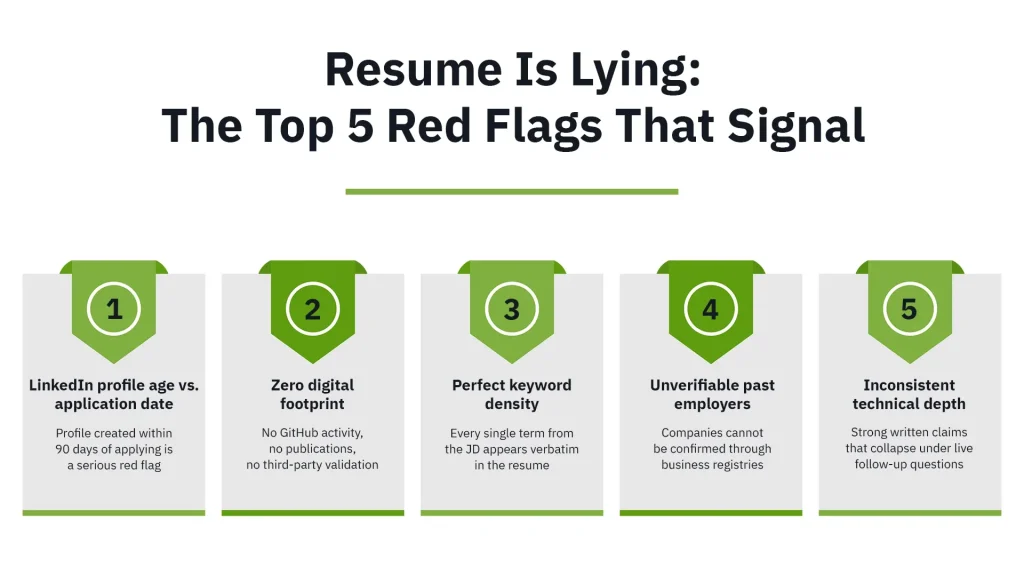
What are the Strategies for Vetting Candidates in the Machine Age
Hiring teams cannot rely on old playbooks. When machines write the profiles, humans must change the rules of engagement.
1. Mandate Up-Front Identity Assurance
Do not wait until the final offer stage to verify a candidate. Implement government-issued ID checks at the initial application step. This immediately disrupts automated bots and synthetic personas before they reach a human recruiter.
2. Introduce Live, Adaptive Technical Vetting
Ditch static take-home assignments. Generative tools solve standard coding challenges instantly. Shift to live assessments where candidates must explain their logic verbally while modifying work on the fly.
3. Conduct Thorough Forensic Reference Vetting
Do not just call the phone numbers listed on a resume. Fraud rings build entire fake companies complete with functional websites and AI-powered voice bots to act as references. Look up the referencing managers independently on verified enterprise networks.
4. Implement Behavioral Synchronicity Checks
Watch for subtle anomalies during video interactions. Look for audio delays, unnatural lip movements, or strange background blurring. These signs indicate real-time face-swapping software or remote proxy interviews.
5. Transition to a Verified Pipeline Framework
Stop building talent pipelines from unverified public job boards. Prioritize talent pools that require multi-factor identity confirmation before a profile can even enter the database.
What Recruiting Teams Must Do Right Now
Intuition is not a process. Neither is “culture fit.” Both collapse when the resume itself is fiction.
Three things matter immediately.
Verification layers. Employment history must be confirmed through independent channels. References alone are not enough.
Assessments that can’t be faked. Async video screens are increasingly gameable. Live technical assessments are not.
Structured shortlisting. Every candidate should meet a verified, reasoned standard. Here’s what fast, verified, reasoned shortlisting looks like.
And consider what getting it wrong costs. Are recruiters accidentally burning $100K every time they trust a polished resume?
Gartner projected in late 2025 that by 2027, over 60% of enterprise hiring decisions would involve AI-generated candidate materials. The verification infrastructure to match that volume does not exist yet.
That gap is where fraud lives. It is also the heart of a deeper problem explored in The AI Hiring Paradox: How the Technology That Promised to Fix Recruiting Created Its Biggest Trust Crisis.
Key Takeaways
- Generative tools make it impossible to evaluate skills or truthfulness based on a written document or digital profile.
- Nation-state actors and fraud rings routinely weaponize automated applications to infiltrate corporate networks.
- Legacy screening software rewards the exact keyword optimization that algorithms generate effortlessly.
- Recruitment teams must move from passive screening to continuous, forensic verification at the very top of the funnel.
Final Thoughts
The resume is no longer a document of truth. It is a document of effort; sometimes legitimate, sometimes manufactured.
Hiring teams that win in 2026 won’t be the ones that trust faster. They will be the ones that verify smarter.
Speed still matters. But speed without verification is exactly how organizations end up surviving the toxic fallout of a bad hire or not.
The question is no longer “Does this resume look good?”
The question is: “Can you prove it?”
Get a hands-on experience now. Try One Role for Free.
Frequently Asked Questions (FAQs)
1. Can recruiters reliably detect AI-generated resumes using standard ATS platforms?
No. Legacy ATS platforms are built for keyword matching, the exact behavior AI tools exploit. Recruiters need human-led verification layers beyond automated filtering.
2. Should talent acquisition specialists require identity verification before the interview stage?
Yes. Verifying government-issued ID at the application step eliminates synthetic personas and bot-submitted profiles before they ever reach a recruiter.
3. Are staffing agencies legally exposed when they place a fraudulent candidate with a client?
Yes. Negligent placement claims are rising. Agencies without documented verification processes face growing legal and financial liability from clients.
4. Can recruiting teams trust async video interviews as a reliable fraud prevention measure?
No. Real-time face-swap tools and AI voice models make async screens increasingly gameable. Live adaptive assessments are significantly harder to fake.
5. Should talent acquisition specialists treat LinkedIn profile age as a formal screening signal?
Yes. Profiles created within 90 days of an application strongly indicate a synthetic identity. It takes under two minutes to check.
6. Are recruiting teams at real risk of unknowingly onboarding state-sponsored threat actors?
Yes. Federal agencies confirmed North Korean operatives have infiltrated North American organizations using AI-fabricated identities and fake U.S. employment histories.
7. Can staffing agencies rely on standard reference calls to confirm a candidate’s actual work history?
No. Fraud networks build fake companies with live websites and AI voice bots acting as references. Independent registry verification is essential.
8. Should talent acquisition specialists apply the same fraud scrutiny to senior roles as entry-level ones?
Yes. Senior technical roles are primary targets. Higher salaries and system access make them more attractive to organized fraud rings.