

The executive team at a high-growth fintech startup celebrated their latest hire. A Cloud Architect who aced every remote challenge. Three weeks later, corporate infrastructure collapsed. Security ran the logs and found the local IP mapped directly to a proxy server network in East Asia. The person writing the code was an anonymous bad actor using a stolen identity.
Resume fraud by industry is not a new problem. But AI has turned it into a fundamentally different one, and the sectors getting hit hardest are the ones where a bad hire carries the most damage.
Beyond Exaggeration: AI Has Weaponized Hiring
For decades, hiring managers treated resume discrepancies as minor inflation. That view is now dangerous. The gap between harmless puffery and outright fabrication matters more than ever, because generative AI has turned resume fraud by industry from casual embellishment into an industrialized epidemic. Sophisticated bad actors now use specialized platforms to auto-generate fully fictionalized career histories. These tools crawl job boards, scrape role-specific data, and output resumes built to beat ATS algorithms.
HR analyst Josh Bersin has pointed out that AI now enables candidates to construct entirely fictional professional identities — complete with matching writing samples, portfolio pieces, and reference personas — faster than any recruiter can catch them. If your team is still debating where the line between resume inflation and outright fabrication actually sits, that conversation may be overdue.
A 2026 Greenhouse report revealed that 86% of recruiters have caught or suspected candidate fraud within the past 12 months. For organizations asking whether this problem is genuinely escalating, the answer is clearly yes. And that’s why recruiting teams need forensic proof rather than surface-level intuition.
Resume Fraud by Industry: Where It Hits Hardest
Technology and Cybersecurity
This is the epicenter. The North Korean state-sponsored fake IT worker operation, documented by both the FBI and the BBC across multiple investigations, continued escalating into 2026. Operatives apply for remote developer and security roles at Western firms using stolen identities, AI-generated portfolios, and fabricated profiles. In one 2026 case reported by the Financial Times, a European staffing agency unknowingly placed six suspected DPRK-linked contractors into infrastructure roles across three client accounts before detection.
Generative AI makes this scalable. A realistic-looking portfolio of “past projects,” complete with technical write-ups and credential screenshots, can be assembled overnight. Staffing agencies without robust staffing agency candidate verification infrastructure are running open exposure.
Healthcare
SHRM’s 2025 workforce integrity research ranked healthcare consistently among the top sectors for credential fraud. Nursing licenses, CPR certifications, and specialty training documents are frequently faked or borrowed outright. In fast-fill environments like travel nursing and locum tenens, the volume and velocity of placements create the exact gaps fraudulent candidates exploit. The financial cost is serious. The patient safety cost is worse.
Finance and Accounting
Series 7 licenses. CPA designations. Compliance certifications. These credentials are auditable and still frequently fabricated. Forbes reported in early 2026 that financial services firms saw a sharp year-over-year increase in credential fraud detections, with AI-generated documentation consistently passing initial ATS screening. Hiring intelligence tools that were not built to flag AI-produced inputs are already behind.
Legal and Compliance
Bar admissions, jurisdictional experience, and case histories are highly specific and difficult for non-legal hiring managers to verify at speed. Staffing firms placing contract paralegals and compliance officers are reporting coherent, well-written work histories that are entirely fictional. The firms burning through placements and wondering why are often the ones who haven’t formalized verification as a step in their process.
Engineering and Construction
PE licenses, safety certifications, and project management credentials are commonly inflated or fabricated in this sector. Infrastructure investment across North America has created exactly the conditions fraud thrives in: high demand, speed pressure, and stretched teams looking for shortcuts..
Fast-Growing Startups
Startups are uniquely exposed and rarely talk about it. Hiring moves fast, HR infrastructure is thin, and every role is critical. A fraudulent “Head of Growth” or a fabricated “VP of Engineering” can sink a product roadmap, burn runway, and quietly damage investor confidence before anyone catches the pattern. Because startups often hire for roles they’ve never filled before, they have no internal benchmark to measure a candidate’s claims against. That makes resume fraud by industry particularly dangerous here: there’s no institutional memory to trip the wire. The cost of one bad executive hire at a Series A company is not just the salary. It’s the six months of misaligned decisions that follow.
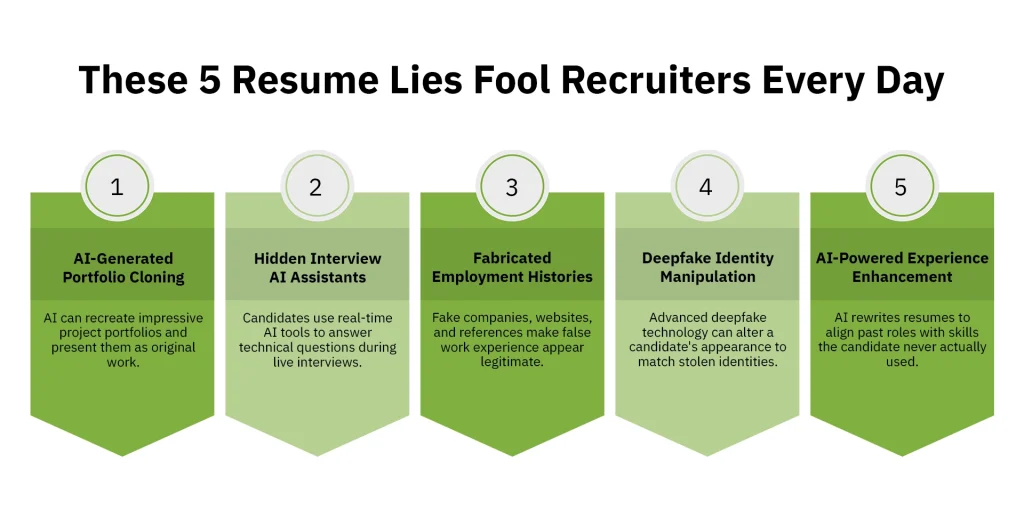
Top 5 Resume Lies AI Makes Easier
- Cloned Repositories: AI can instantly replicate complex engineering portfolios and masking them under synthetic profiles.
- Real-Time Interview Copilots: Applicants utilize hidden on-screen AI assistants to listen to live technical questions and feed them perfect conversational answers.
- Synthetic Corporate Backgrounds: Fraudulent platforms generate verifiably fake corporate entities, including realistic placeholder websites and AI-generated references.
- Deepfake Video Identification: Advanced video rendering software allows proxy candidates to alter their appearance during live video screening sessions to match stolen IDs.
- Automated Experience Mapping: Candidates use agentic tools to seamlessly align historical bullet points with modern tech stacks they have never deployed.
What Firms Are Getting Wrong
Most recruiting teams treat verification as admin. It’s not admin. It’s forensic work. Ben Eubanks, who tracks how talent technology actually gets adopted inside organizations, has pointed out that the same tools firms use to screen candidates are being used by candidates to game those screens. That symmetry is the problem.
When your team is spending hours chasing down documents and cross-referencing claims manually, they are doing data entry, not recruiting. That is not what high-performing hiring teams look like.
Trusting a polished PDF without a structured verification layer is how $100K gets quietly incinerated on every resume a recruiter takes at face value. And it is why AI in recruiting has left so many practitioners feeling like they were handed a tool that works against them.
The firms building ahead are moving toward shortlists that are fast, verified, and reasoned rather than just fast. They treat verification as a hiring intelligence function, not a checkbox. And the ones still getting burned are usually the ones falling for beautifully formatted PDFs that tell a great story with zero grounding in reality. Resume fraud by industry moves fast. Unverified shortlists move faster.
As the conversation around what recruiters can actually trust when AI writes the resume continues to grow, the answer is becoming clear: not the document itself.
Key Takeaways
- Modern hiring deception has moved past simple inflation into highly coordinated, machine-generated identity fabrication.
- Over one-third of non-proctored technical assessments now involve some form of automated assistance or proxy cheating.
- Traditional background checks confirm document validity but fail to verify the actual candidate’s physical identity.
- High-growing startups face severe financial risks when speed overrides robust identity verification protocols.
- Implementing modern hiring intelligence at the point of submission protects internal recruiting teams from widespread exploitation.
Final Thoughts
Fraudulent candidates are not going to slow down. The tools are too good, the demand for talent is too high, and the verification gaps are too wide. Every firm that treats a candidate’s documents as proof rather than a starting point is absorbing risk it has not priced in. The good news: verification that actually works exists. Try for Free and see what your shortlists look like when every candidate on them is confirmed, not assumed.
Frequently Asked Questions (FAQs)
Q1. Are staffing agencies more financially exposed to resume fraud by industry than in-house corporate hiring teams
Yes. Staffing agencies absorb client fallout, replacement costs, and reputational damage when a fraudulent placement fails.
Q2. Can recruiting teams use hiring intelligence tools to catch fabricated credentials before the interview stage?
Yes. Hiring intelligence platforms flag credential inconsistencies early, stopping fraudulent candidates before they reach the interview.
Q3. Should talent acquisition teams treat candidate verification as a non-negotiable step in every placement?
Yes. Without structured staffing agency candidate verification, fabricated credentials routinely pass screening and reach the offer stage.
Q4. Does resume fraud by industry hit recruiting teams at fast-growing startups harder than those at established enterprises?
Yes. Startup recruiting teams lack internal benchmarks and HR infrastructure, making every fraudulent hire more damaging.
Q5. Are recruiters trained to detect AI-generated resumes the same way they would catch a manually falsified one?No. AI-generated resumes are precision-built to pass ATS filters and fool recruiters relying on document-based screening.
Q6. Does resume fraud by industry increase when talent acquisition teams prioritize speed over structured verification processes?
Yes. Speed-first hiring creates verification gaps that fraudulent candidates are actively trained to identify and exploit.
Q7. Can recruiters reliably detect proxy candidates or deepfake video fraud during standard live screening interviews?
No. Most recruiters lack the technical tools to identify AI-rendered video substitution during a standard video call.
Q8. Is staffing agency candidate verification enough on its own, or do hiring teams also need ongoing hiring intelligence monitoring?
No. Verification at submission is the start. Hiring intelligence adds the ongoing layer that one-time checks cannot provide.