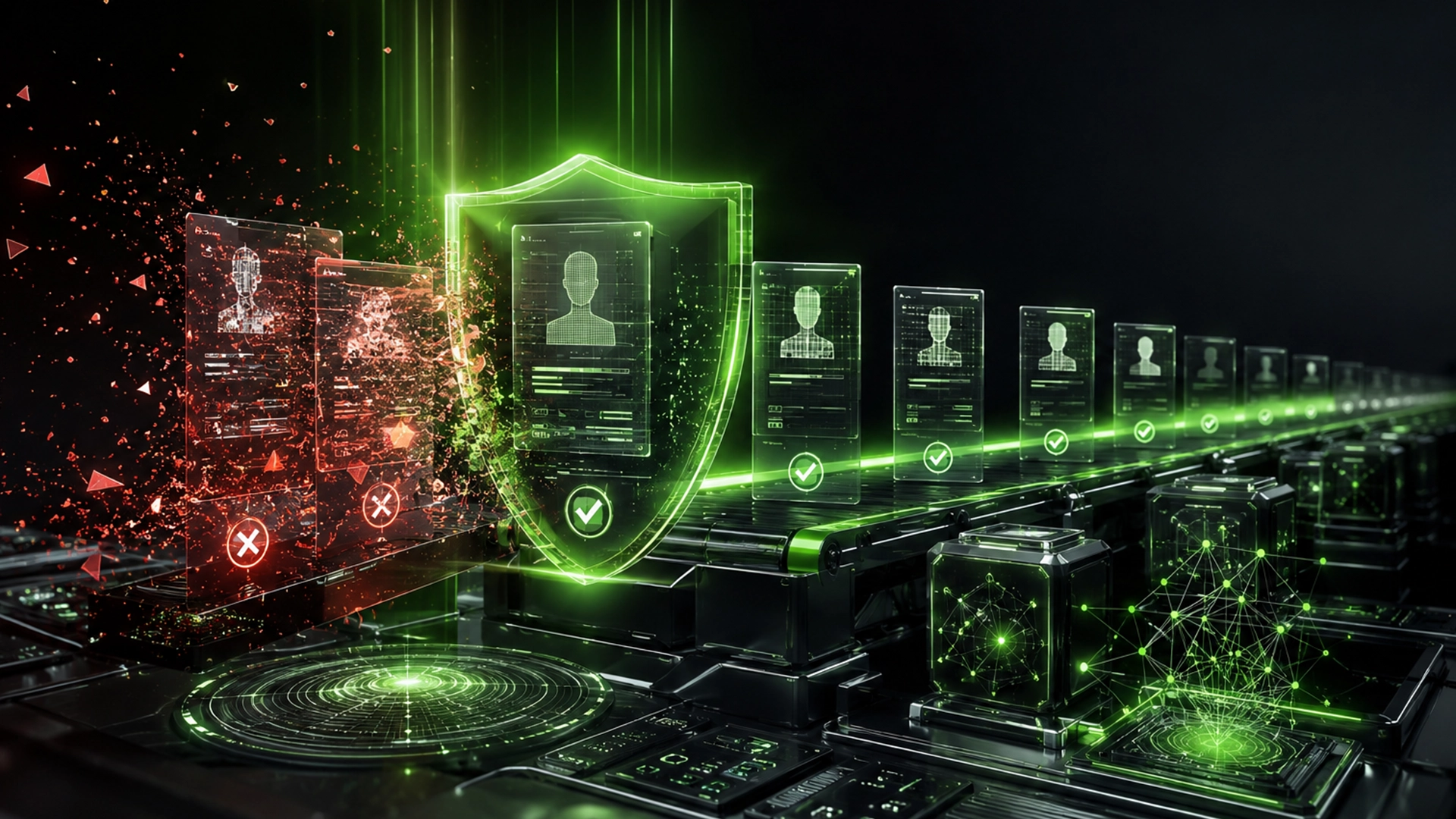

Someone on a shortlist your team submitted last quarter lied. Not exaggerated. Not inflated. Lied. The degree did not exist. The employer had no record of them. The reference was a friend returning a favor. This is not speculation. Resume fraud now touches an estimated one in three applications at the screening stage, and candidate fraud has become organized, AI-assisted, and nearly invisible to traditional review.
Stop synthetic candidate scams today. Advanced AI candidate verification identifies resumes lie instantly to keep your hiring pipelines clean and safe.
The question is not whether it is happening in your pipeline. It is whether AI candidate verification is catching it before the client does, and whether your hiring intelligence layer is actually built to stop it.
The Line Between Inflation and Fabrication
Not every embellished resume is candidate fraud. A candidate who rounds 4 years to 5 or claims a slightly grander title than what HR would confirm, is inflating. That is a problem, but it is manageable.
Fabrication is different. Invented degrees. Made-up employers. AI-generated references that sound entirely credible. That is fraud, and the fallout for agencies that miss it is expensive, reputation-destroying, and sometimes legal.
Without AI candidate verification built into the sourcing workflow, fabrication slips through the screening stage at every turn. Where the line actually sits between resume inflation and outright lying is something every staffing firm needs to define before the next client submission goes out.
The North Korean Problem: Why It Escalated Everything
Resume fraud stopped being just an HR problem the moment nation-state actors got involved.
North Korean operatives have been systematically infiltrating Western companies using AI-generated resumes, deepfake profiles, stolen American identities, and voice-altering software. In 2026, the BBC reported on a broader pattern: professional proxy interviewers completing technical assessments on behalf of fraudulent candidates, with entirely different individuals showing up on day one. Microsoft’s threat intelligence team confirmed these actors use AI to maintain employment even after being hired.
What this looks like across the industries most targeted by organized credential fraud is sobering. Data breaches, IP theft, federal investigations. The exposure is catastrophic, and it starts with a resume that passed a standard screen.
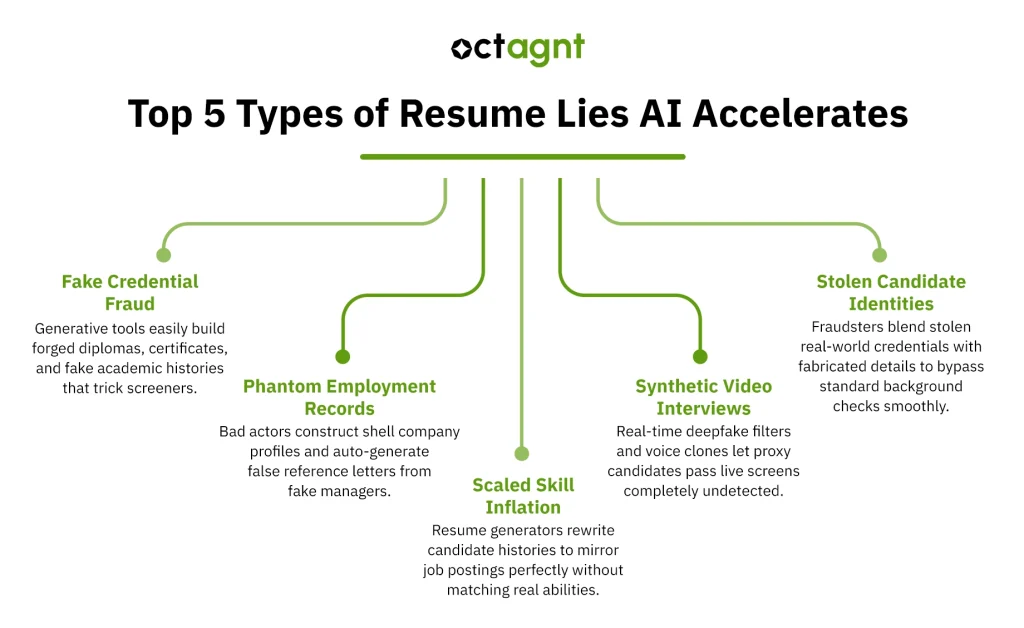
5 Types of Resume Fraud AI Makes Easier Than Ever
These are the fabrications spiking in volume, and the ones most traditional screening processes miss entirely. Candidate fraud detection AI is the only tool designed to catch them before they reach a client.
- Credential fabrication: Fake degrees, fake certifications, purchased diplomas from diploma mills. AI can generate convincing PDF certificates and build backstories that match.
- Employment history fraud: Shell company employers, fabricated job titles, AI-generated reference letters from non-existent managers. Verifying these manually takes hours most recruiters do not have.
- Skill inflation at scale: AI resume builders analyze a job description and rewrite a candidate’s experience to mirror the exact competencies listed. The resume matches perfectly. The person does not.
- Deepfake video interviews: AI-generated faces and voices used to pass video screenings. The person who interviews is not the person who shows up. This is no longer theoretical.
- Identity theft and synthetic personas. Stolen real-world identities combined with fabricated credentials, creating composite candidates that pass background checks designed for legitimate applicants.
Knowing how to spot a fake degree or fabricated credential before it reaches a client is now a foundational recruiting skill, not an advanced one.
Why Modern Hiring Demands AI Candidate Verification
Legacy background checks happen too late in the hiring funnel. They run after a candidate receives an offer, relying heavily on candidate-provided data. If the initial identity is fake, a standard background check simply validates a stolen persona.
Deploying AI candidate verification at the top of the funnel changes the game entirely. HR technology analyst Ben Eubanks highlights that shifting verification upstream protects recruiters from wasting hours interviewing ghost candidates.
A robust hiring intelligence layer sits between the applicant screening stage and the final interview. It runs instant cross-validation on candidates before human screeners waste valuable time. When recruiting teams use automated AI candidate verification, they deliver fast verified shortlists that build permanent client confidence.
Recruiters cannot afford to rely on gut feelings. A candidate who seems great on paper can easily turn out to be a deepfake actor. Modern staffing agencies must build in credential checks that catch fabrication before the interview stage to protect brand reputation.
Without a candidate fraud detection AI layer in place, firms are left defending placements built on fiction from the very first PDF. Organizations that adopted early recruitment automation often wonder why recruiters feel betrayed by basic AI tools. The answer is simple: basic resume parsers help candidates cheat, while specialized AI candidate verification platforms expose the lie.
How a Hiring Intelligence Layer Catches What Recruiters Miss
The same technology enabling fraud is now being used to catch it, and the capabilities are moving fast.
AI candidate verification operates as a hiring intelligence layer that sits between the ATS and the interview. It does not just read what a resume says. It validates whether what the resume says is real.
Here is what that looks like in practice.
- Cross-referencing against primary sources
Verified employment history means checking whether the employers on a resume actually exist, whether the candidate’s tenure can be confirmed through public records or professional network data, and whether the claimed titles align with the company’s organizational structure during that period.
- AI content detection
Modern candidate fraud detection AI tools flag resumes generated by AI writing platforms with high confidence. The linguistic patterns of AI-generated content are statistically distinct from human writing, and the tools trained to detect them are getting more accurate every month.
- Identity verification beyond the document
Forensic verification confirms that the person who submitted the application, completed the interview, and will appear on day one are the same individual. This matters enormously in remote hiring pipelines, where deepfake risk is highest.
- Credential authentication
Degree verification, licensing checks, and certification validation against issuing institutions. Not against what a PDF claims. Against the source.
Recruiting teams that rely exclusively on ATS scoring are operating without this layer entirely. Trusting a polished PDF as a hiring document is no longer a neutral decision. It is a financial risk with a documented price tag.
The shift the industry needs is away from “who interviewed well” and toward “who this person actually is.” Staffing firms ensuring every submission is backed by evidence rather than a confident handshake are the ones surviving this environment with client relationships intact.
For agencies wondering whether their current process is built for this, the question is whether their recruiters are equipped to make evidence-based decisions or are still relying on impression management. Burying recruiting teams in manual verification admin without the right tools is not a strategy. It is a liability.
Key Takeaways
- Resume fraud has moved well beyond casual exaggeration
- AI now makes full-scale fabrication fast, cheap, and nearly undetectable without forensic verification tools
- Gartner projects that by 2028, 1 in 4 candidates will be fraudulent or significantly misrepresented
- AI candidate verification works by validating identity, credentials, and employment history against primary sources
- The hiring intelligence layer is no longer optional
- It is the difference between a defensible hire and an expensive disaster.
Final Thoughts
AI candidate verification is not a future capability. It is available now, and the firms deploying it alongside a purpose-built hiring intelligence layer are already separating themselves from those still running candidates through a glorified keyword matcher.
The fraud is real. The volume is increasing. The cost of getting it wrong, to a recruiting firm’s reputation, a client’s security, and an HR leader’s credibility, is too high to absorb through gut instinct and a strong handshake.
Every fraudulent hire that slips through is a decision that candidate fraud detection AI could have prevented. The technology exists to catch these candidates in minutes. The only question is whether your process is built to use it.
Try Octagnt for Free and see what forensic-level AI candidate verification looks like on a real role.
Frequently Asked Questions (FAQs)
1. What is AI candidate verification and how does it work?
AI candidate verification is a process that uses artificial intelligence to validate a candidate’s identity, credentials, employment history, and resume authenticity against primary sources. Rather than reading a resume at face value, it cross-references claims against external records to detect fabrication, inflation, or identity fraud.
2. How is candidate fraud different from resume inflation?
Resume inflation involves stretching or exaggerating real experience: bumping up a title, overstating a skill. Candidate fraud involves outright fabrication: fake employers, invented credentials, stolen identities, and deepfake profiles. AI has made the latter far easier to execute and far harder to detect without dedicated verification tools.
3. Why are staffing agencies and recruiting firms especially at risk?
Staffing firms and agencies bear direct accountability for who they place. A fraudulent candidate damages the agency’s credibility with the client, creates legal exposure, and can permanently end a business relationship. The financial and reputational stakes are higher than for internal hiring teams.
4. Can ATS systems detect AI-generated resumes or fraudulent profiles?
No. Standard ATS tools match keywords against job descriptions. They do not verify identity, authenticate credentials, or detect AI-generated content. Candidate fraud detection AI requires a separate verification layer that operates beyond what an ATS is designed to do.
5. Can AI candidate verification detect deepfake video screens during recruiter interviews?
Yes. Modern verification tools analyze biometric frame rates, audio latency, and visual artifacts to catch synthetic video feeds instantly.
6. Should talent acquisition teams use AI candidate verification to stop offshore job-proxy scams?
Yes. System algorithms track IP proxies and candidate geolocation markers to stop unauthorized offshore networks from passing initial screenings.
7. Will implementing AI candidate verification protect recruiting teams from the financial costs of bad hires?
Yes. Verifying applicant authenticity before interviews stops fake candidates from entering pipelines, saving agencies thousands in placement losses.