

The notification pings at 4:45 PM on a Thursday. It is the hiring manager you have been trying to impress for six months. They are ecstatic because the candidate you sent over for the Senior Software Developer role looked like a literal unicorn on paper. The interview happened an hour ago. You expect a rave review or a request for a second round. Instead, the tone is ice cold.
Why? The candidate could not explain the basic architecture of the projects listed on their own resume. They stumbled over fundamental logic questions. Even worse, the hiring manager felt like they were talking to a completely different person than the one described in your glowing summary. In thirty minutes, your credibility evaporated. The hours you spent sourcing, the outreach, and the vetting all went down the drain because one person decided to let an AI bot write their experience and inflate their skills.
This is the nightmare scenario for every recruiter. It is not just about a missed placement. It is about your reputation. In an era where resumes are being manufactured by algorithms, your word is the only currency you have left. If that word is backed by a lie, you are in trouble.
The Trust Crisis in the Age of Synthetic Talent
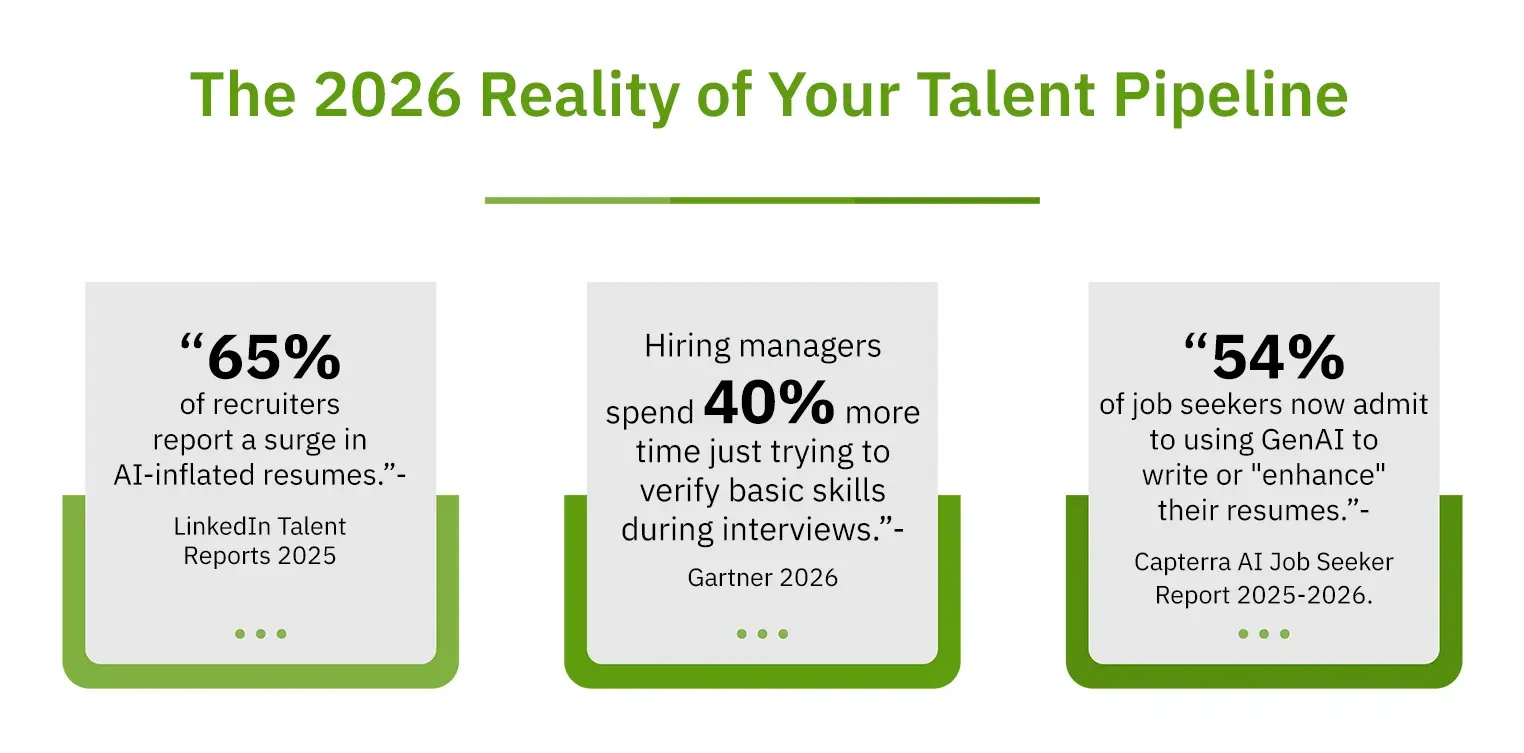
We have officially entered the era of the ghost candidate. According to recent 2025 data from LinkedIn Talent Reports, nearly 65 percent of recruiters in North America report a significant surge in candidates using AI to misrepresent their actual technical abilities. It is no longer just about a little bit of “embellishment” on a CV. We are seeing full scale identity fraud and skill fabrication.
A 2026 report by Gartner highlighted that hiring managers now spend 40 percent more time in interviews just trying to verify if the person sitting in front of them actually knows what they claim to know. The New York Times recently covered the “Resume Arms Race,” where job seekers use sophisticated tools to bypass ATS filters, effectively tricking the system into thinking they are a perfect match.
The problem is that as a recruiter, you are caught in the middle. You are under pressure to move fast, but the traditional tools for verification are failing. When you submit a candidate who turns out to be a “paper tiger,” the client doesn’t blame the candidate. They blame you. They start to wonder if you actually did the work or if you just passed along a shiny PDF without looking under the hood.
The Shift From Sourcing to Proving
For the last decade, recruitment was a game of “find the person.” If you could find the hidden talent on LinkedIn or a niche job board, you won the game. But today, sourcing is the easy part. We are drowning in candidates. The hard part is knowing which ones are real.
The industry is undergoing a fundamental shift. We are moving away from a “Sourcing Economy” and into a “Verification Economy.” It is no longer enough to provide a list of names. You have to provide proof. A shortlist that is just a collection of links and resumes is a liability. A shortlist that is verified and reasoned is a high value asset.
In this new reality, “looking perfect” is actually a red flag. If a resume is too clean, too keyword-optimized, and too perfectly aligned with the job description, it is often a sign of AI generation rather than actual career progression. The goal for modern recruiters has changed. You aren’t just a talent scout anymore. You are a truth layer.
The Framework That Changes Everything
There are three things a hiring manager actually needs from a shortlist. Not ten. Not a long methodology deck. Three.
Fast
Speed is not optional in hiring. It never has been. But the stakes have gotten higher because the best candidates are now off the market faster than ever, and clients are increasingly measuring recruiter value by time-to-shortlist as much as shortlist quality.
Delays kill placements. A shortlist that arrives a week late, no matter how polished, often arrives after the client has already moved. The expectation from most clients is a credible shortlist within 48 to 72 hours. For retained search, the window is wider. But for contingency and time-critical roles, speed is everything.
The trap most recruiters fall into is treating speed and quality as opposing forces. The faster they move, the less they verify. The more they verify, the slower they go. So they pick one. And usually they pick speed, because that is what the client is asking for out loud, even if what they actually need is quality.
The solution is not to choose. It is to build a process where verification does not slow you down.
Verified
This is the pillar that most recruitment processes handle the worst.
Verification should mean more than a background check run after an offer has been made. By that point, the damage is often already done. A candidate who made it through three rounds of interviews before a credential discrepancy surfaced has already consumed significant time, energy, and goodwill.
Verification at the shortlist stage means confirming identity, validating the authenticity of the resume, detecting AI-generated or artificially inflated content, cross-referencing employment history against verifiable data points, and flagging signals that suggest the person submitting an application may not be who they claim to be.
Given that 74% of hiring managers say they are more concerned about fake credentials, deepfakes, and misrepresented experience than they were just a year ago, pre-submission verification is not a nice-to-have feature. It is the new baseline for a credible shortlist.
Reasoned
The third pillar is the one that is almost never talked about, but clients notice its absence immediately.
When a client opens a shortlist and sees six names, they are not just evaluating the candidates. They are evaluating the recruiter’s thinking. Why these six people? What makes them the right fit for this specific role, in this specific team, at this specific stage of growth? A name without a reason is just a lead. A name with a reason is a recommendation.
Reasoned shortlisting means demonstrating skill alignment, explaining career trajectory logic, and connecting each candidate’s background to the actual requirements of the role rather than the keywords in the job description. It makes the recruiter look sharp. It saves the client time. And it signals that the person who built the shortlist actually thought about the work rather than running a search and forwarding the results.
Explainability is now a competitive advantage in recruitment. The recruiters who can say “here is exactly why this person is on this list” will win the room every time over those who say “they seemed like a good fit.”
How Octagnt Changes the Game
We realized that recruiters were being asked to do the impossible. You are expected to vet candidates deeply, verify their claims, and do it all in record time. Traditional background checks happen too late in the process, usually after the offer is made. That doesn’t help you when you are building your shortlist.
Octagnt is the “Truth Layer” for recruitment. We don’t just find people. We validate them.
Our platform integrates directly into your workflow or work independently to verify and validate candidates before you ever hit “send” to your client. Our verification engine looks for fraud signals, cross-references career history, and validates skills through logical evidence within 24 hours.
When you use Octagnt, you aren’t just passing along a resume. You are passing along a verified profile with immutable audit trail. You can see exactly where the candidate’s strengths lie and, more importantly, you have the data to back it up. We help you identify the AI-inflated resumes and the “keyword stuffers” before they ever get a chance to embarrass you in an interview.
Before and After: One Role, Two Outcomes
| Step in Process | Without Octagnt | With Octagnt |
| Initial Sourcing | Find a candidate who looks amazing on paper and sounds good on a phone screen. | Find the same candidate but immediately apply the Octagnt verification layer. |
| Verification | ❌ No deep validation. You rely on the candidate’s word and AI-generated descriptions. | ✅ System flags a 90% match with AI templates and identifies skill misalignments. |
| Submission | ❌ You send the candidate to the client based on “gut feel” and keyword matching. | ✅ You pass on the “paper tiger” and submit a shortlist of three fully verified people. |
| Client Interview | ❌ Candidate fails to perform. The client feels their time was wasted. | ✅ The hiring manager is impressed by the depth of your vetting and candidate quality. |
| The Result | ❌ Relationship damaged. You have to start the entire search from scratch. | ✅ Deal closed. You secure your reputation as a top-tier, trusted recruiter. |
Trust is the New Currency
In a world full of noise, the person who speaks the truth wins. Stop sending resumes and hoping for the best. Start sending proof. Your clients don’t want more candidates. They want more certainty.
When you provide a shortlist that is fast, verified, and reasoned, you aren’t just filling a seat. You are building a brand. Octagnt is here to make sure that brand is unbreakable. Try one role for free now.
Key Takeaways
- Your reputation is tied to candidate quality; one AI-inflated resume can destroy months of client relationship building
- Every shortlist must be Fast (48-72 hours), Verified (authentic identity/skills), and Reasoned (clear explainability)
- Verification must happen before submission, not just before the offer, to save time and maintain credibility
- Octagnt Advantage: Use a “Truth Layer” to automate the detection of synthetic talent and provide evidence-backed recommendations
Frequently Asked Questions (FAQs)
-
Do recruiters lose credibility when candidates fail interviews?
Yes, when candidates fail to validate their claims, clients often question the recruiter’s screening process, which directly impacts trust and long-term professional relationships. -
Is verifying candidates before submission becoming necessary?
Yes, with rising cases of resume fraud and AI manipulation, pre-submission verification is becoming essential to maintain shortlist quality and protect recruiter credibility. -
Can recruiting teams use automated verification to actually speed up the hiring process?
Yes. By eliminating fake profiles early, recruiting teams slash their Time-to-Fill and prevent wasted interview cycles, significantly accelerating the overall hiring process. -
As a recruiter, is standard ATS keyword matching sufficient for shortlisting today?
No, keyword matching often misses real skill alignment and can be easily manipulated, leading to mismatched candidates and failed interview outcomes. -
Does Octagnt help an individual recruiter improve their placement success rates?
Yes, by verifying and validating candidates before submission, Octagnt reduces interview failures and increases the chances of successful placements. -
Does Octagnt allow recruiting teams to verify candidate credentials before submission?
Yes. Octagnt acts as a pre-submission truth layer, validating identity and skills before you ever hit send to protect your professional reputation. -
Is the recruiter’s 48–72 hour shortlist window compromised by adding verification?
No. Octagnt is designed to integrate into your workflow, allowing you to provide a verified shortlist within the critical 48 to 72-hour window. -
Can recruiters get specific “reasoning” from the platform to justify a candidate fit?
Yes. It offers evidence-backed validation and career trajectory logic, helping you explain the “why” behind every hire. -
Can I try Octagnt for a single role without a long-term commitment?
Yes. You can experience the verification engine by trying one role for free to see how it secures your standing with clients. Try For Free – One Role: 150 Candidates · Every Month.