
Summary
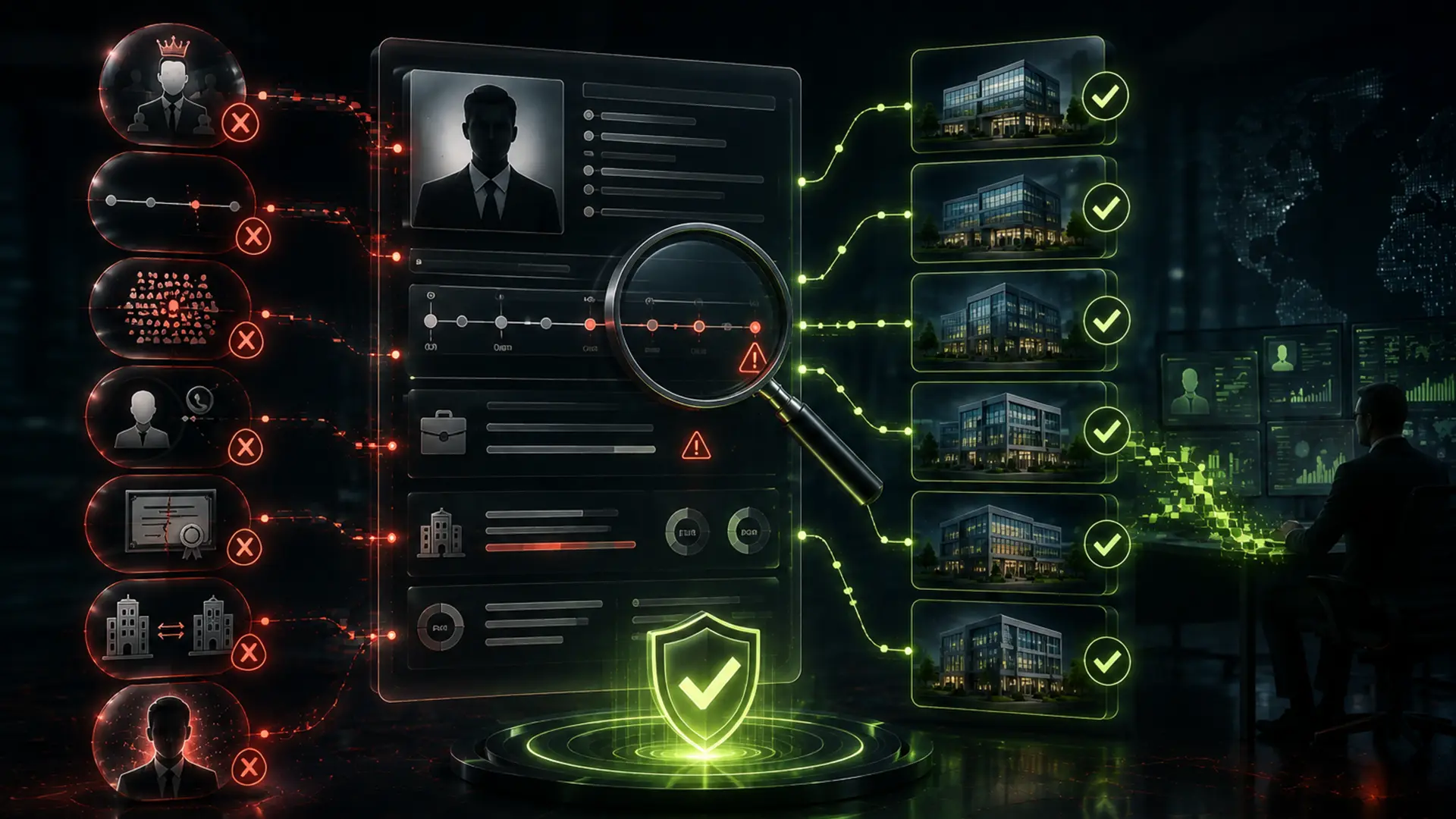
A flawed employment verification process lets fraudulent candidates slip through. Here are 6 fixable mistakes that cost hiring teams time, money, and the wrong people.
Ben Eubanks, the HR technology analyst behind Lighthouse Research and Advisory, has long pointed out that most talent acquisition teams still verify candidates the same manual, informal way they did a decade ago, even as fraud tactics have gotten dramatically more sophisticated. That gap matters more than ever. The employment verification process most companies run today was built for a slower, more honest hiring market — not one where AI tools help candidates fabricate work histories in minutes. If you want to understand just how recruiters are getting fooled every week by resumes in the age of AI, the answer starts with the broken verification workflows described below.
Recruiters are not careless. They are working with outdated playbooks. Here are six mistakes that keep showing up, and what actually fixes them.
The Employment Verification Process Most Teams Still Rely On
Ask any recruiter how they confirm a candidate’s background and the answer usually involves a phone call, a LinkedIn glance, and a gut check. That approach worked when resume padding meant rounding up a job title. It does not work against deliberate resume fraud built with AI assistance. For a full breakdown of how modern resume lying actually works, see this complete guide to how resumes lie — what candidates fake, how it gets through, and how agencies stop it.
The reality is that many hiring teams are already being catfished by polished PDFs and falling for resume fiction without realizing it. This is not a rare failure. It is the default outcome when employment verification relies on candidate-curated inputs rather than independently sourced evidence.
7 Red Flags That Expose a Fraudulent Resume
Verifying work history looks straightforward on paper. Contact a previous employer. Confirm the job title, employment dates, and eligibility for rehire. Move forward.
The reality is more complicated.
Many HR departments at former employers are legally coached to confirm only basic details. Managers who would speak candidly are often unreachable or unavailable. Reference contacts provided by the candidate are, by definition, curated. And the sheer volume of applications most hiring teams manage leaves little time for thorough background checks or structured follow-up.
This creates a verification gap. Recruiters believe they have validated a candidate’s background. What they have actually done is confirm a narrow slice of it — often the slice the candidate prepared for them. SHRM data consistently shows that hiring managers overestimate how much a standard reference call reveals about a candidate’s actual experience. What the resume fraud statistics for 2026 actually say will likely make you rethink your last five hires.
The problem compounds when organizations conflate two distinct activities: confirming who a candidate is, and confirming whether their claims are credible. These are separate tasks. Conflating them produces a process that does neither reliably. Understanding where resume inflation ends and actual resume lies begin is essential to designing a pre-employment verification process that closes the right gaps — not just the obvious ones.
What AI Has Changed About Employment History Fraud
Resume fraud has always existed. What has changed is the production quality. AI promised to fix recruiting — so why do so many recruiters now feel betrayed by it? The answer lies in how generative tools shifted from a recruiter’s advantage to a candidate’s weapon almost overnight.
Candidates with access to generative AI tools can now produce résumés with internally consistent work histories, plausible company names, realistic tenure patterns, and language that mirrors legitimate industry experience. The Guardian reported in 2024 that AI-assisted job application tools are being openly marketed to candidates, some explicitly advertising help with embellishing qualifications. When AI writes the resume, what is left for recruiters to actually trust?
A recruiter reading a polished résumé cannot tell the difference between genuine experience and a well-crafted fabrication. Neither can an applicant tracking system. ATS platforms were built to rank keyword relevance and parse formatting. Detecting candidate fraud is not part of their design. A fraudulent résumé that uses the right keywords moves through the funnel exactly like a legitimate one.
The downstream cost of this is not abstract. Forbes has documented cases where undisclosed credential gaps led to direct financial losses, legal liability, and reputational damage for organizations. The application-stage fraud problem is not a future risk. It is a present one — and the good news is that AI is now catching resume liars in minutes, and here is how it works.

6 Things Recruiters Keep Getting Wrong in the Employment Verification Process
1. Treating candidate-supplied references as independent confirmation
When a candidate provides their own reference contacts, they are selecting who speaks on their behalf. This is not verification. It is testimony from a curated witness list. Independent outreach to employers — using contact information sourced separately from the candidate — produces a more reliable signal. Your shortlists should be fast, verified, and reasoned — with evidence behind every submission, not built on references the candidate hand-picked.
2. Accepting job titles at face value without cross-referencing
Job titles are not standardized across industries or organizations. A candidate may list a title that was internally informal or significantly inflated relative to their actual responsibilities. Verifying employment history means confirming scope, reporting structure, and team size — not just the label on a business card. The industries where resume fraud is most rampant often show patterns of title inflation that look credible on the surface but collapse under structured scrutiny.
3. Stopping at dates and title without probing for gaps
Short-term roles, consulting periods, and unexplained gaps in employment history are frequently where application fraud hides. A verification process that only confirms the roles listed will miss the roles that were omitted. Structured gap analysis should be a standard step in every employment background check workflow. These unexplained gaps are among the most important resume red flags recruiters must catch before the first call costs them a client.
4. Conflating verification with validation
Knowing that a candidate worked at a company is verification. Knowing whether their stated contributions and accomplishments at that company are credible is validation. These are different questions that require different approaches. Organizations that treat a confirmed employment date as full-picture validation are leaving significant risk on the table. What recruiting teams actually need is forensic proof — because a candidate who merely seems great is not a hiring strategy.
5. Relying on self-reported LinkedIn profiles as a verification source
LinkedIn data is user-generated. Candidates control what they post, how they describe their roles, and when they update their profiles. Checking a candidate’s LinkedIn against their résumé can surface inconsistencies, but it does not constitute verification of employment history. Both sources originate from the same person. How to spot a fake degree before you make a client submission starts with never treating any self-reported credential — LinkedIn profile included — as independently verified fact.
6. Delaying the process until the final stage.
Many hiring teams run employment verification only after a verbal offer. By that point, the organization has invested significant time, internal stakeholder attention, and sometimes candidate relocation conversations. Discovering misrepresentation at that stage is costly in every sense. A single nice-guy resume can silently cost your organization more than $100,000 in hidden hiring losses — and that figure compounds when a fraudulent hire reaches a senior or client-facing role. Earlier-stage verification, built into the pipeline rather than appended to it, reduces exposure before investment accumulates. Your recruiters also deserve a workflow that does not reduce them to data entry clerks buried in admin work that automated verification tools should be handling.
Key Takeaways
- Manual verification methods like resume-listed phone numbers are easy for candidates to control and easy for fraud to slip through.
- ATS platforms were built to filter resumes, not verify them, which leaves a structural gap in most hiring workflows.
- AI has made candidate fraud more sophisticated, not just more common.
- Roughly 20 to 30 percent of formal background checks turn up a discrepancy in employment history, based on long-running industry surveys.
- Verification needs to happen at the application stage, before ATS filtering, not after an offer is extended.
Final Thoughts
The employment verification process was built for a different hiring environment. One where résumés were typed, references were candid, and fraud required significant effort. That environment no longer exists.
Hiring fraud is faster to produce, harder to detect, and more costly to discover after the fact. The toxic fallout of a single hiring mistake extends well beyond the recruitment team — it affects client relationships, team morale, and organizational reputation in ways that take months to repair. The six mistakes outlined here are not obscure edge cases. They are the standard gaps that exist in most high-volume hiring operations, and they persist because the tools most teams rely on were never designed to catch them.
Fixing these gaps does not require rebuilding the entire hiring process. It requires separating verification from validation, removing candidate-controlled inputs from the evidence chain, and building checks in earlier, not later.
Octagnt was built to do exactly that. Try for Free
Frequently Asked Questions (FAQs)
Q1. Should recruiters be concerned about resume fraud when verifying entry-level candidates?
Yes. Recruiters underestimate resume fraud at entry level, where fabricated internships and inflated GPA claims are increasingly common and difficult to detect.
Q2. Can TA specialists verify work history using LinkedIn as a primary source?
No. TA specialists cannot reliably verify work history through LinkedIn alone because all profile content is user-generated and candidate-controlled without independent oversight.
Q3. Do talent acquisition leaders need a separate process for validation beyond standard background check employment history tools?
Yes. Talent acquisition leaders need separate validation steps because standard background check employment history tools confirm dates and titles, not the credibility of claimed accomplishments.
Q4. Are staffing professionals legally protected if they unknowingly place a candidate who committed application fraud?
No. Staffing professionals placing candidates who committed application fraud may face legal and contractual liability depending on jurisdiction, client agreements, and disclosed verification practices.
Q5. Can recruiting teams catch resume embellishment by cross-referencing multiple candidate-supplied documents?
No. Recruiting teams cross-referencing candidate-supplied documents cannot catch resume embellishment reliably because all those materials originate from the same unverified source.
Q6. Do hiring teams need to verify work history for contract or freelance roles, or only permanent positions?
Yes. Hiring teams should verify work history for contract roles too because fraudulent candidates misrepresent project scope, client names, and deliverables just as frequently as full-time history.
Q7. Should TA specialists flag hiring fraud risk when a candidate provides references only from former direct reports?
Yes. TA specialists should flag hiring fraud risk when references come only from former direct reports, as this pattern avoids peer and managerial perspective entirely.
Q8. Can HR leaders distinguish resume embellishment from legitimate self-promotion without a structured validation process?
No. HR leaders cannot reliably distinguish resume embellishment from legitimate self-promotion without a structured validation process that goes beyond interview impressions alone.