

Summary
Fake resumes are climbing faster than most hiring teams realize. Read the 2026 data before your next bad hire happens.
Would the last five resumes on the shortlist survive a real background check? Most hiring teams never ask that question, and that gap is exactly what the resume fraud statistics 2026 data keeps exposing. Somewhere between the confident cover letter and the polished LinkedIn profile sits a candidate who may have built an entire career story out of half-truths, or out of nothing at all.
This is not the old story of a rounded-up job title. This is candidate fraud, engineered and scaled with AI, and it is landing directly in HR inboxes.
The Resume Fraud Statistics 2026 Employers Can’t Ignore
Ask how many people lie on resumes and the honest answer has been consistent for years: most of them, at least a little. Industry surveys have long found that a large majority of job seekers, commonly cited above 70% across multiple studies, admit to lying or exaggerating somewhere on a resume. That is not a fringe behavior. That is the baseline.
The fake resume rate hiring teams are grappling with in 2026 goes further than embellishment. Gartner research publicized in 2025 projected that by 2028, roughly 1 in 4 job candidates globally could be fake, built from stolen identities, AI-generated profiles, or a blend of both. That is not a distant hypothetical. Recruiting pipelines are already absorbing candidates who do not exist in the way their application claims.
New recruitment fraud cases keep surfacing as detection tools improve and reporting catches up, a reminder that this is an active, evolving threat rather than a one-time scare.
5 Numbers Every Hiring Team Should Know About Candidate Fraud
- Over 70 percent: the share of job seekers who admit to lying or exaggerating on a resume, according to long-running industry surveys.
- 20 to 30 percent: the range of formal background checks that turn up a discrepancy against what the candidate originally claimed.
- 1 in 4: Gartner’s projected share of global job candidates that could be fake by 2028, combining identity fraud and AI-generated profiles.
- Zero: the number of identity or credential checks a standard ATS performs before ranking a resume.
- Unlimited: the number of AI tools now available to a candidate who wants a flawless, fabricated work history in minutes.
These numbers are worth pulling into a shared slide deck or a one-page infographic, because most leadership teams have never seen the background check failure rates laid out this plainly.
Why AI Made Resume Embellishment a Bigger Problem
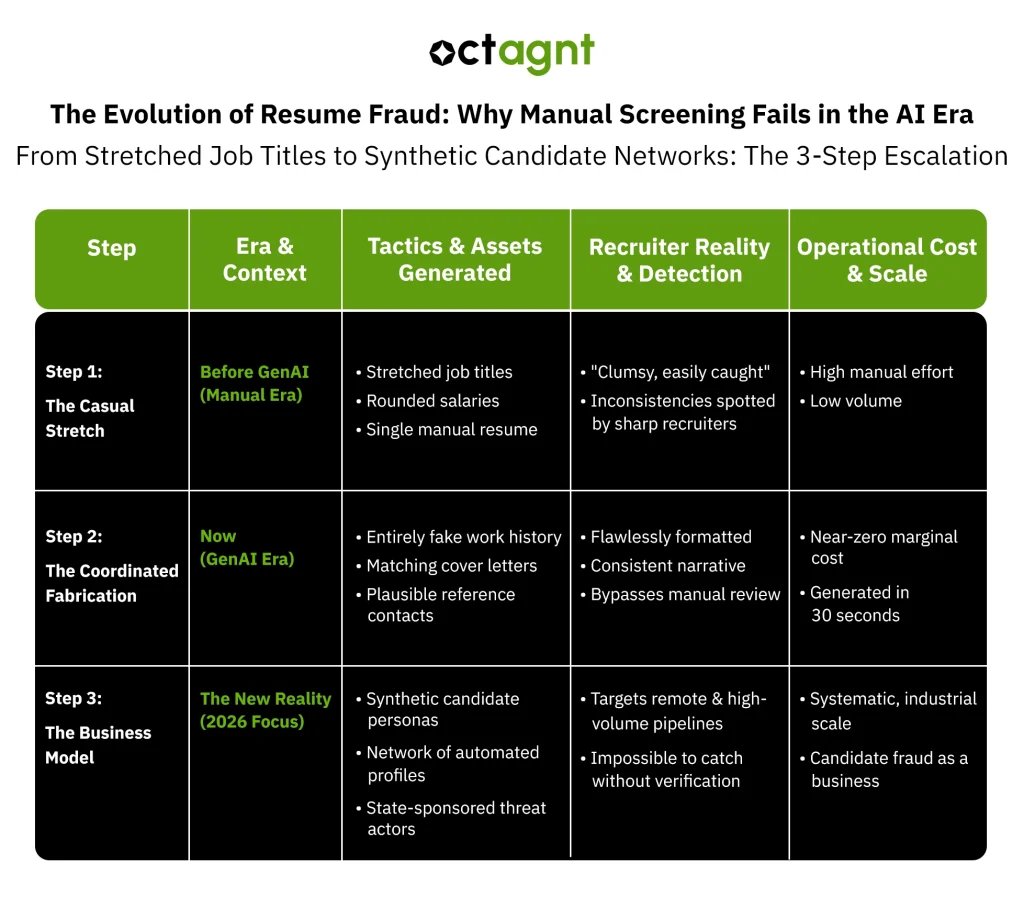
Resume embellishment used to mean a stretched job title or a rounded-up salary. It was clumsy, and a sharp recruiter could usually spot it. AI changed the economics of lying. Generative tools can now produce a consistent, detailed, entirely fabricated employment history, complete with plausible reference contacts and matching cover letters, in the time it takes to write a real one.
That shift turns casual resume misrepresentation into something closer to a business model. It has been described as resume inflation becoming its own art form, a craft candidates can now practice at scale rather than by instinct. Some industries are absorbing this harder than others, and recent analysis suggests AI is making resume fraud far worse across sectors that rely heavily on remote hiring and high application volume.
The ATS Blind Spot
Here is the structural issue nobody likes to say out loud. An Applicant Tracking System (ATS) was built to filter and rank resumes by keywords. They were never built to verify identity, confirm employment history, or validate credentials. That job was always meant to happen somewhere else in the process, usually much later, if at all.
By the time a background check runs, the fraudulent resume has already cleared the ATS, impressed a hiring manager, and maybe made it through two rounds of interviews. Catching resume fraud has to happen at the application stage, before the ATS ever sees the file, not after an offer has already gone out. Waiting until the background check stage means the damage from a fabricated hire is already baked into onboarding costs, lost productivity, and team disruption.
Key Takeaways
- Over 70% of job seekers admit to lying or exaggerating on a resume, and that number has held steady across years of industry surveys.
- Background check failure rates in the 20 to 30% range show discrepancies are common, not rare.
- Gartner research points to 1 in 4 global candidates potentially being fake by 2028.
- ATS platforms filter resumes by keywords, not by truth. Verification is a separate job entirely.
- Fraud detection needs to start at the application stage, not after the interview loop.
Final Thoughts
None of this data is meant to make hiring teams paranoid, it is meant to make them prepared. Verifying candidates before the ATS ever ranks them is how HR leaders stop paying for fraud after the fact. Octagnt was built to close that exact gap, and teams can Try for Free to see how verification at the application stage changes the quality of every shortlist that follows.
FAQs
1. Can hiring managers rely on an ATS to catch resume misrepresentation?
No, hiring managers cannot rely on an ATS, since it filters keywords only and was never designed to verify claims.
2. Do TA specialists see more fake resumes because of AI tools?
Yes, TA specialists report more fake resumes now, since AI tools make fabricating consistent, believable work histories faster than before.
3. Should talent acquisition teams expect resume embellishment on most applications?
Yes, talent acquisition teams should expect resume embellishment on most applications, since surveys show a majority of candidates admit exaggerating.
4. Is candidate fraud limited to entry-level hiring, according to recruiters?
No, candidate fraud is not limited to entry-level hiring, since fabricated credentials and identities appear across seniority levels and industries.
5. Can hiring managers catch resume fraud after the interview stage reliably?
No, hiring managers cannot reliably catch resume fraud after interviews, since verification needs to happen earlier, at the application stage.
6. Do background checks always uncover resume misrepresentation before an offer?
No, background checks do not always uncover misrepresentation, since a meaningful share of checks still miss discrepancies candidates never disclosed.
7. Should recruiters verify credentials before candidates ever reach an ATS ranking?
Yes, recruiters should verify credentials before ATS ranking, since fraud caught early prevents wasted interview time and flawed hiring decisions.
8. Can hiring managers assume a polished resume means no candidate fraud risk?
No, hiring managers cannot assume a polished resume is safe, since fraud is often more convincing and better disguised now.