

By 2028, the resume red flags recruiters are overlooking as minor inconsistencies will represent deliberate candidate fraud in one out of every four profiles. That is Gartner’s confirmed finding from 2026. Not a future warning. The pipeline sitting in front of hiring teams right now.
Here is what that looks like in practice.
A senior recruiter at a regional staffing agency submitted a candidate for a financial services director role in early 2026. The resume was clean and detailed. LinkedIn matched. Both references came back warm and responsive. Client extended an offer within ten days. Six weeks into the role, the client called back. Not to say thank you. The employer listed for the candidate’s last seven years had no record of her. The graduate degree had been purchased through an offshore credential mill for under $400. References were coached personal contacts using prepaid numbers. The placement collapsed. The client relationship ended. Agency spent the next quarter rebuilding trust it had taken three years to earn.
That recruiter was not reckless. They did what most recruiting teams do every day: trust a well-formatted document without verifying what is behind it. The resume red flags recruiters need to catch today are not visible on a resume scan. They require a process built for verification, not just volume. Candidate screening that depends on first impressions is a liability that compounds quietly until it does not.
The Line Between Resume Embellishment and Candidate Fraud
Resume embellishment has always existed. Stretched titles. Compressed gaps. Achievements described more broadly than they were experienced. These are manageable, familiar risks. Resume fraud is a different category. A fabricated employer. A purchased degree. Reference network that exists entirely as a coordinated deception. These are not exaggerations. They are candidate fraud, and treating them as equivalent to embellishment is the mistake that leads to six-figure replacement costs.
Understanding exactly where that line sits before the screening process begins shapes every downstream decision. Because surface confidence is not a hiring standard. Forensic proof is.
How AI Made Resume Fraud the Epidemic Resume Red Flags Recruiters Now Face
Any candidate can generate a polished, keyword-dense, ATS-optimized resume in under ten minutes. That is not an exaggeration. The problem is not the output quality. The problem is that AI-generated resume fraud reads identically to legitimate professional experience. There are no obvious inconsistencies in the language. The formatting is cleaner than most genuine resumes.
Forbes reported in 2026 that resume fraud investigations inside enterprise HR teams rose 42 percent year over year. Josh Bersin has been direct about what that means operationally: the gap between what resumes claim and what verification confirms has never been wider, and most recruiting teams have no infrastructure to close it. The uncomfortable reality that AI promised to transform recruiting but introduced new vulnerabilities instead is a conversation most firms are only beginning to have internally. The harder question — what hiring teams can actually rely on when AI is authoring every candidate document — does not have a comfortable answer yet.
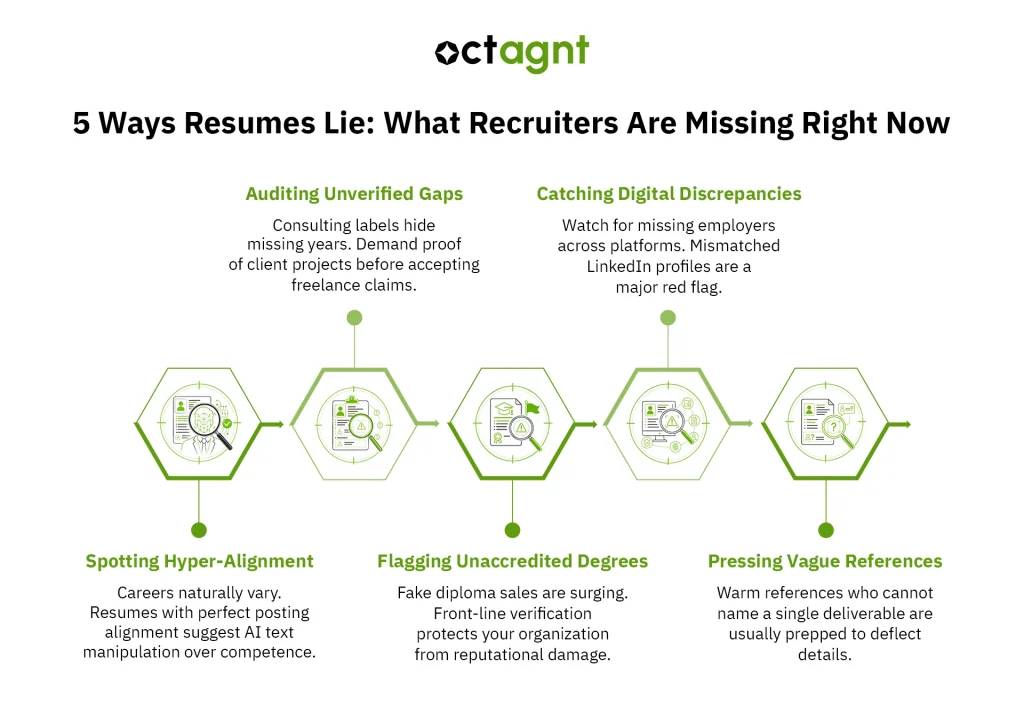
5 Resume Red Flags Recruiters Are Missing Right Now
- Resumes that match the job description with structural precision.
Real careers do not naturally align with every bullet point in every posting at a sentence-rhythm level. AI-optimized resumes do. That degree of alignment is a pattern, not a qualification.
- Freelance gaps with no verifiable clients, projects, or deliverables.
Self-employment is the cleanest cover for chronological fraud. It fills gaps, sounds legitimate, and resists scrutiny without active verification.
- Credentials from unaccredited or offshore institutions.
SHRM confirmed in 2026 that over 200,000 fake degree certificates were sold to North American job seekers through offshore credential mills in a single-year period. Catching a fake degree before making the client submission is now a front-line hiring intelligence skill, not a post-offer formality.
- LinkedIn histories that do not match the resume.
Not minor date discrepancies. Missing employers. Missing years. Job titles that appear nowhere in any public professional record. Recruiters being misled by clean, well-formatted documentation is one of the most documented patterns in 2026 fraud research, and one of the most preventable.
- References that are enthusiastic but cannot name a single deliverable.
Coached references share a consistent behavioral pattern: they respond fast, speak warmly, and go vague the moment a specific project comes up. The financial and reputational fallout of missing that signal is avoidable when verification is built into intake, not tacked onto the offer stage.
Ben Eubanks of Lighthouse Research has noted that resume fraud is systematically underreported in part because most organizations have no clear escalation process when informal screening surfaces a concern.
ATS Was Not Built to Catch the Resume Red Flags Recruiters Face
Application tracking systems sort candidates by keyword relevance. They filter volume. Advanced applications through a pipeline based on text matching. They were never designed to verify a degree, cross-reference an employer, or identify a fabricated reference. Treating ATS output as a candidate screening layer for fraud detection is a structural error.
Resume misrepresentation has to be intercepted at the application stage, before recruiter time, client trust, or placement revenue gets committed to an unverified candidate. A shortlist that has not been verified against primary sources is not a shortlist. It is a stack of unconfirmed claims dressed as qualified candidates. And every unverified resume processed at volume represents financial exposure that most agencies never calculate until after the placement fails and the client conversation gets uncomfortable.
The 2026 Fraud Schemes That Changed Hiring Intelligence Forever
The BBC confirmed in 2026 that North Korean state-sponsored actors had embedded remote IT workers inside Western companies through third-party staffing agencies, using stolen identities and fully constructed employment histories. The candidates moved through standard recruiting pipelines undetected. Agencies made the placements in good faith. Legal and compliance consequences followed.
That is the extreme end. But the mechanics underneath it are not isolated. A complete picture of what candidates fabricate and how it moves past standard screening shows that fraud is not concentrated where most firms are watching. The sectors where resume fraud grew fastest in 2026 include financial services, healthcare, and logistics alongside tech. The operational shift worth noting: AI-powered verification is now catching fraud patterns at the application stage in minutes. The same technology that made fabrication easier is being deployed to detect it, but only inside firms that have made verification a process requirement rather than an occasional check.
Key Takeaways
- The resume red flags recruiters miss most often involve credential mismatches, unverifiable employment history, coached references, and chronological gaps — not formatting errors.
- ATS was built to sort, not verify. Candidate screening that relies on ATS output alone leaves fraud detection to chance at every stage.
- Gartner’s 2028 projection is already visible inside 2026 pipelines. Forbes confirms fraud investigations are up 42 percent year over year across enterprise hiring functions.
- Hiring intelligence means verifying substance before any human time or client trust is invested, not after confirmation bias has already set in.
- Recruiters buried in unverified resume review at volume are absorbing fraud risk without the infrastructure to manage it.
Final Thoughts
The resume red flags recruiters catch before the first call protect placements, preserve client relationships, and keep agencies out of damage-control conversations that should never have happened. Candidate fraud is accelerating. The tools to stop it at the application stage exist and are already being deployed by firms that cannot afford to learn this lesson the hard way.
Try Octagnt for free and see what forensic candidate screening looks like before the first call ever happens.
Frequently Asked Questions (FAQs)
1. Is resume embellishment the same as resume fraud, and should recruiting teams treat them differently?
No. Embellishment inflates real experience. Resume fraud fabricates it entirely. Recruiting teams must treat them as separate, escalating risks.
2. Can the resume red flags recruiters are trained to spot actually catch AI-generated candidate fraud?
No. AI-generated candidate fraud produces clean, polished documents that contain none of the traditional resume red flags recruiters recognize.
3. How do resumes lie without including a single technically false statement?
Yes, this happens constantly. Resumes lie through selective framing, real facts arranged to create a completely false professional impression.
4. Are staffing agencies legally exposed when candidate fraud leads to a failed client placement?
Yes. Undetected resume fraud shifts liability to the agency once a placement is made and a client is harmed.
5. Is ATS-based candidate screening reliable enough to catch resume misrepresentation before the first call?
No. ATS ranks keyword matches, not truth. Resume misrepresentation moves through candidate screening undetected because ATS was never built for verification.
6. Does resume embellishment in talent acquisition pipelines always involve fabricated credentials or fake employers?
No. Most resume embellishment uses real facts, reframed. Talent acquisition teams focused only on fabrication miss the majority of misrepresentation.
7. Can a recruiting team build hiring intelligence processes that catch resume fraud before the first call?
Yes. Hiring intelligence built around intake verification catches resume fraud before confirmation bias, client submissions, or placement fees are on the line.
8. Do the resume red flags recruiters miss most often involve outright lies, or something more subtle?
No. Resume red flags recruiters miss most are patterns: coached references, clean narratives, gaps; not crude, easily spotted fabrications.