

Summary
Most staffing agencies think they’re screening candidates. Few actually verify them. Discover what a real candidate verification process inside a staffing agency looks like.
A recruiter submits a candidate. The client hires them. Three months later, the hire unravels. The credentials were fabricated. The experience was inflated. The agency takes the call.
This scenario is no longer rare. Resume misrepresentation has grown more convincing, more targeted, and harder to catch at the application stage. Staffing agencies sit at the center of that risk. They are the filter between candidates and clients. Yet the tools most agencies rely on for the candidate verification process staffing agency teams actually use were never designed to detect fraud. They were designed to sort resumes by keyword and format. That gap is where real exposure lives.
This post breaks down what genuine pre-submission verification looks like inside a staffing agency, and why the difference between checking a box and actually verifying a candidate matters more than it ever has.
Why the Standard Screening Process Was Never Built for Fraud Detection
Most staffing agencies follow a familiar intake sequence. Resume review. Phone screen. Skills assessment. Reference call. Submission.
Each step feels thorough. None of it is verification.
Resume review reads what the candidate wrote. A phone screen confirms the candidate can speak to their experience, not that the experience is real. Skills assessments measure current ability, not historical accuracy. Reference calls, when conducted at all, often connect back to contacts the candidate supplied.
The result is a process that validates presentation, not truth.
ATS platforms compound the problem. These systems parse resumes for keyword density and format compliance. They rank candidates by surface-level match. They were built to reduce recruiter workload at scale. Fraud detection was never part of the design.
According to SHRM, roughly 85% of employers have caught candidates lying on resumes or applications. Staffing agencies, submitting dozens of candidates per week across multiple clients, carry that risk in bulk. A single fraudulent placement can cost an agency a client relationship it took years to build.
The tools that sort candidates cannot protect agencies from candidate fraud. That requires a fundamentally different approach.
The Difference Between Verification and Validation in a Staffing Context
These two terms get used interchangeably. They are not the same thing, and the distinction matters operationally.
Verification answers one question: Is this person who they say they are? It confirms identity. It cross-references that the individual presenting themselves to the agency is the individual attached to the credentials being claimed. This is foundational. Without it, everything else a recruiter does rests on an assumption.
Validation answers a different question: Are the claims on this resume credible? It examines whether stated employment timelines, role titles, educational qualifications, and skill sets hold up when measured against independent data. A candidate might be exactly who they say they are, and still have a resume built on embellishment.
Both functions are necessary. Neither replaces the other.
Staffing agencies that treat a background check as the answer to both are operating with a significant blind spot. Traditional background checks are post-offer tools. They run after a placement decision has been made. By that point, the agency has already submitted the candidate, the client has already interviewed them, and the hiring process is deep enough that reversing course is costly for everyone.
Application-stage fraud is most efficiently addressed before submission, not after a conditional offer.
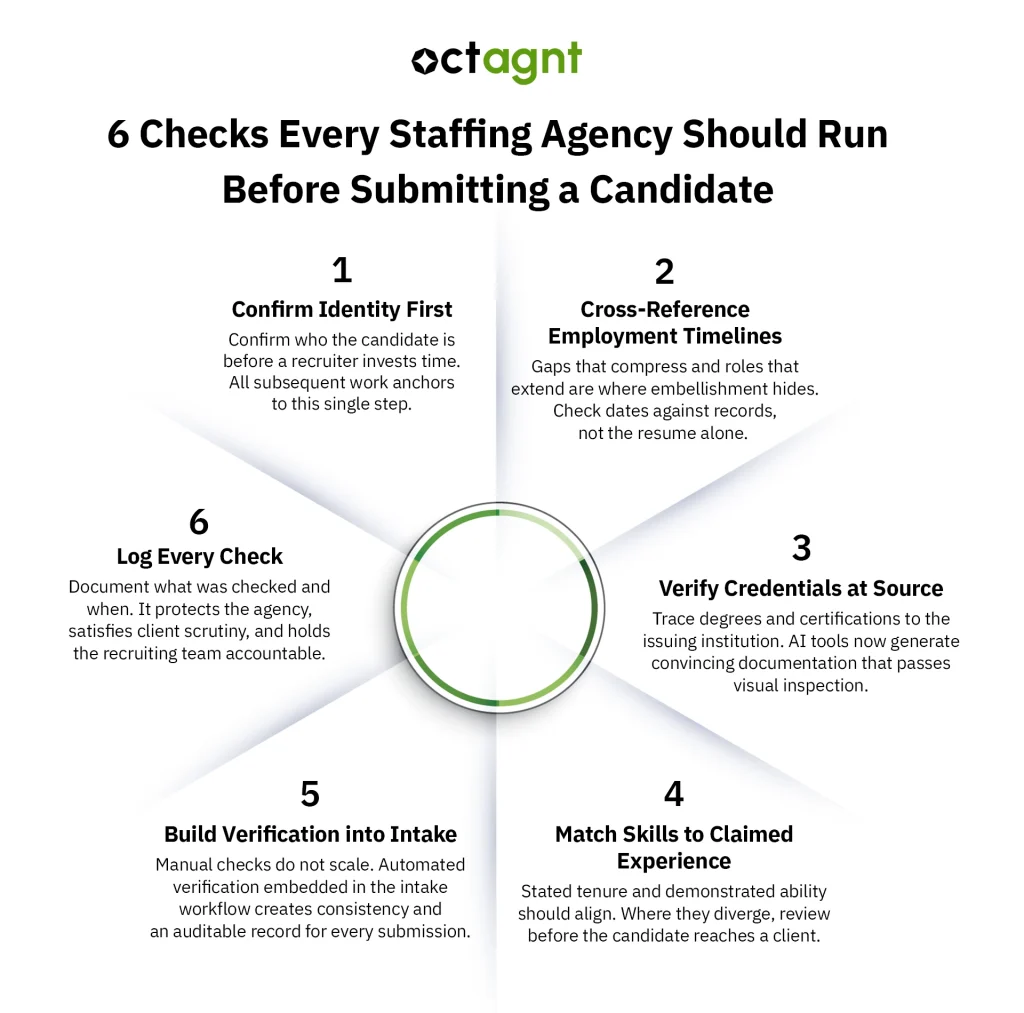
6 Pre-Submission Candidate Checks That Actually Reduce Fraud Risk
1. Identity confirmation before anything else
Before a recruiter invests time in a candidate, the agency should confirm that the person is who they claim to be. This is not a background check. It is a foundational step that anchors all subsequent work to a verified individual, not an unconfirmed profile.
2. Employment timeline cross-referencing
Dates on a resume should be compared against verifiable records, not just accepted. Resume embellishment most commonly appears in employment gaps that get compressed or roles that get extended. Flagging inconsistencies before submission protects the agency from placing a candidate whose career narrative does not hold.
3. Credential and qualification checks against source data
Degrees, certifications, and licenses should be traced back to the issuing institution or body, not just noted from the resume. Application fraud in this area has grown more sophisticated, with AI tools now capable of generating convincing credential documentation that passes visual inspection.
4. Skills credibility assessment tied to claimed experience
A candidate claiming ten years of experience in a specialized platform should demonstrate proficiency consistent with that tenure. Where significant gaps appear between stated experience and demonstrated ability, that discrepancy warrants closer review before the candidate reaches the client.
5. Automated candidate verification layered into the intake workflow
Manual checks do not scale. Agencies processing high volumes of candidates need automated candidate verification built into the process, not treated as an optional add-on. Automation reduces the time cost of verification while creating a consistent, auditable record for every candidate submitted.
6. A documented pre-submission audit trail
Every check performed should be logged. This protects the agency if a fraudulent candidate slips through. It demonstrates due diligence to clients. And it creates accountability inside the recruiting team for following the process consistently, not just when time allows.
Key Takeaways
- ATS tools sort candidates by keywords and format. They lack capability to detect resume misrepresentation at any stage of the process.
- Verification and validation are distinct functions. Verification confirms identity. Validation confirms that the claims attached to that identity are credible.
- Standard screening steps, including phone screens and reference calls, measure presentation. They do not confirm truth.
- Application-stage fraud is most cost-effective to catch before submission. Post-offer background checks are too late to protect agency-client relationships.
- Automated candidate verification allows high-volume staffing agencies to apply consistent checks without adding unsustainable manual workload.
- Staffing agencies carry concentrated fraud risk. Every candidate submitted is a reflection of the agency’s credibility with the client.
Final Thoughts
Staffing agencies are trusted to do more than source resumes. Clients expect submitted candidates to be who they claim to be and to hold the qualifications listed. That expectation has always existed. What has changed is how convincingly fraudulent candidates can now present themselves, and how far short most agency screening processes fall.
The candidate verification process staffing agency teams need is not the one most are running. It starts with identity, moves through claim validation, and produces a documented record before a single candidate reaches a client.
Agencies that close this gap protect their placements, their client relationships, and their reputation. Those that rely on keyword screens and phone calls alone are absorbing risk they may not see until the damage is done.
Octagnt was built for this exact gap. Try for Free and see what verified submissions actually look like.
Frequently Asked Questions (FAQs)
Q1. Can recruiters tell whether resume fraud is happening before a candidate reaches the client?
Yes, patterns like compressed employment dates and credential inconsistencies signal potential resume fraud before submission occurs.
Q2. What should Hiring managers know about resume embellishment at the application stage?
No, most hiring managers cannot detect resume embellishment through interviews alone without structured pre-submission verification data supporting their review.
Q3. Do TA specialists need dedicated tools to catch candidate fraud during intake?
Yes, TA specialists require purpose-built verification tools because standard ATS platforms have no mechanism for detecting candidate fraud whatsoever.
Q4. How do staffing professionals differentiate between verification and validation when screening candidates?
Yes, staffing professionals should treat identity verification and claim validation as separate, sequential checks addressing distinct dimensions of application fraud risk.
Q5. Can Talent acquisition leaders reduce hiring fraud risk by adding automated checks to intake workflows?
Yes, talent acquisition leaders can significantly reduce hiring fraud exposure by embedding automated candidate verification into every pre-submission workflow step.
Q6. Should HR leaders prioritize pre-submission screening to address resume misrepresentation before offers are made?
Yes, HR leaders should address resume misrepresentation at the application stage because post-offer background checks catch fraud too late.
Q7. What verification steps help Recruiting teams catch fraudulent candidates before they reach client interviews?
Yes, recruiting teams should confirm identity and validate employment timelines to surface fraudulent candidates before any client interaction begins.
Q8. How often do Hiring teams encounter resume embellishment in high-volume staffing environments?
Yes, hiring teams in high-volume environments encounter resume embellishment far more frequently than manual screening processes are equipped to reliably detect.