You Are Catching Candidate Fraud After It Already Cost You

You Are Catching Candidate Fraud After It Already Cost You

This is already happening. The resume sitting at the top of a recruiter’s stack right now might have been written by an AI for a person who does not exist or a person who is nothing like the document describes.

Gartner’s 2025 projection put 1 in 4 job candidates on a path to being entirely fabricated by 2028. Resume fraud, resume embellishment, and resume misrepresentation are not trending toward that number. They are already embedded in the daily intake for most enterprise hiring teams. Forbes reported measurable year-over-year growth in candidate fraud reports from enterprise teams through 2025. Background check providers flag discrepancies in roughly a quarter of the records they verify.

The Guardian documented in 2025 that North Korean IT operatives used stolen American identities to land remote roles at Western technology firms. They cleared phone screens, passed written assessments, and stayed employed for months before discovery. Forbes reported a measurable year-over-year increase in candidate fraud complaints from enterprise hiring teams through 2025. These are not edge cases. They are what candidate fraud looks like when hiring tools were designed for a different problem.

Resumes lie. That is not a hot take. Resumes have always been marketing documents, and AI did not invent resume misrepresentation. It scaled the production. A fabricated employment timeline that once took a day to build now takes 30 seconds, and the output is polished, keyword-optimized, and formatted for ATS ingestion. Applicant tracking systems were designed to filter by relevance. They were never built to verify whether the claims inside a resume are true.

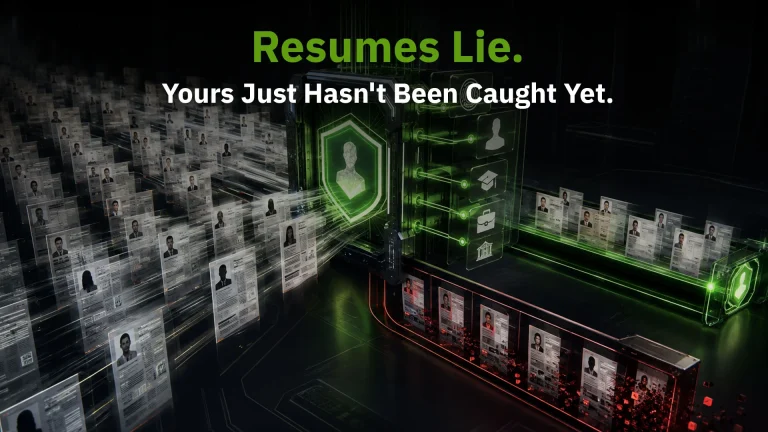
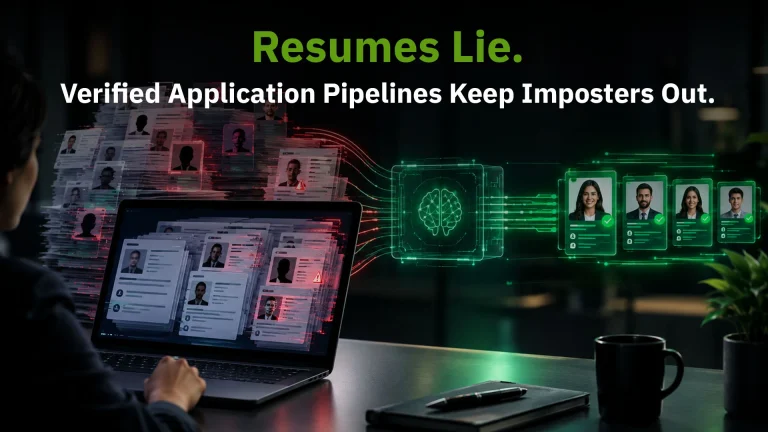
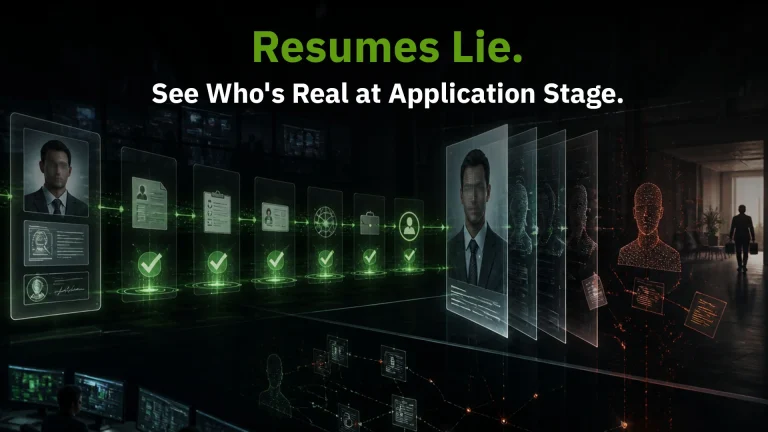
Octagnt catches candidate fraud at the application stage, before any resume reaches a human reviewer. It runs verification across 106 evaluation vectors, checking identity signals, contact authenticity, and employment history consistency against external data sources that candidates do not influence. If the application does not survive verification, it does not move forward. The fraud is caught before it costs a placement.

Validation confirms what verification established. It synthesizes the verified signals into a trust score confirming whether this candidate is who they claim to be, not just whether their data fields are populated.

See how it works at octagnt.ai.

Try a Live Role for Free Now

Frequently Asked Questions (FAQs)

How does resume fraud actually make it through enterprise background checks undetected?

Background checks run post-offer, after fraud already succeeded. They verify identity, not employment history accuracy. Octagnt catches it earlier.

What is the difference between resume embellishment and resume misrepresentation, and why does it matter for hiring?

Embellishment exaggerates real experience. Misrepresentation fabricates it entirely. AI made misrepresentation indistinguishable without external data verification.

Why are AI-generated resumes specifically harder to detect than traditional resume misrepresentation?

AI resumes are polished, keyword-optimized, and ATS-friendly. Traditional screening never checks factual accuracy — just filters by relevance.

How can a hiring team catch candidate fraud before the interview stage without adding weeks to their process?

Octagnt integrates with your ATS and runs verification automatically as applications arrive, delivering verified shortlists within 24 hours.

What does Octagnt's verification process actually check, and how is it different from a standard background check?

Octagnt checks 106 vectors at the application stage — identity signals, contact authenticity, and employment history — before shortlisting.
Share this article

← Back to all articles

Ron Maitra

Ron Maitra is the CEO and Founder of Octagnt.ai. He writes about the hard problems in hiring — resume fraud, deepfake interviews, AI's erosion of trust, and what verification-first recruiting looks like as a fix.

LinkedIn