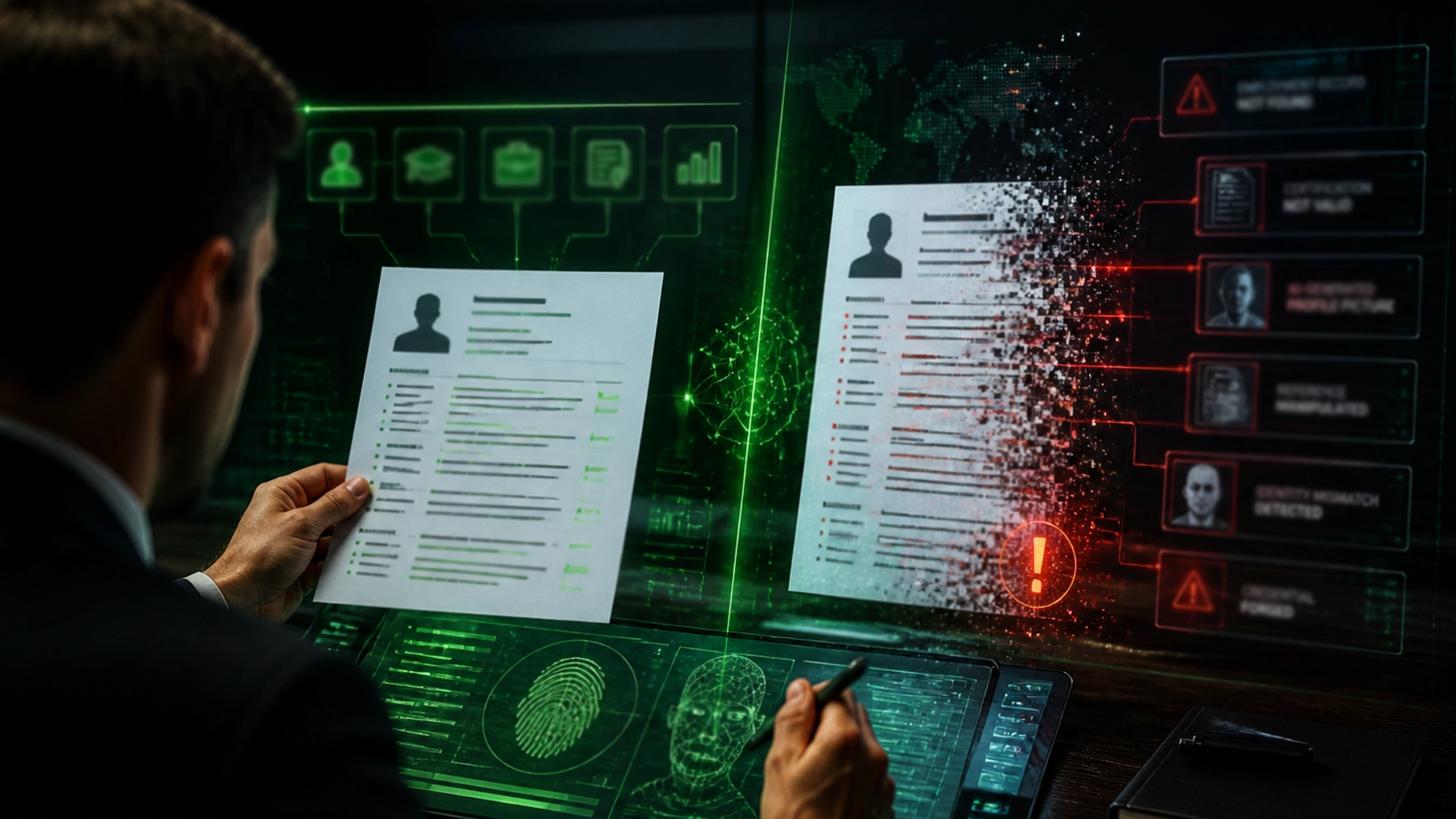

Resume inflation used to be the small, forgivable lie: a padded title, a rounded-up GPA. In 2026, it sits on one end of a spectrum that ends in outright resume fraud and the candidate on the screen was proof of just how far that spectrum stretches. Elite university credentials, deep technical expertise, and an impressive portfolio of enterprise-scale deployments. The staffing agency skipped deep verification because the tech talent shortage demanded speed. Six weeks later, the client company discovered their new network engineer was extracting sensitive financial data. The flawless resume belonged to an actual engineer, but the person on the Zoom calls was a state-sponsored hacker operating out of a completely different region.
Bad hires do not just cost money anymore. They destroy company infrastructure.
Staffing firms and enterprise HR teams face an unprecedented crisis of trust because resume inflation and definitive resumes lie have evolved from minor embellishments into an automated corporate security risk. The boundary between creative resume polishing and outright corporate espionage has completely collapsed.
Resume Inflation vs. Fabrication: Two Very Different Problems
Resume inflation is the quiet negotiation most candidates run. Stretching a title. Rounding up a GPA. Describing a supporting role as if it were a leadership post. Uncomfortable? Sure. Disqualifying? Often not.
Fabrication is something else entirely. That’s inventing degrees, manufacturing employment history, and constructing a professional identity from scratch. It isn’t embellishment. It’s fraud. And the resume lies recruiters once caught with a background check now routinely clear every filter in the intake process.
HR analyst Josh Bersin has observed that as AI-powered ATS filters increasingly gatekeep job applications, candidates feel real structural pressure to inflate credentials, the everyday version of resume inflation, just to get seen. That pressure is partly systemic. But AI has turned it into an industrial pipeline for fake professional personas. The two problems now feed each other, and they no longer look the same.
AI Didn't Create Resume Fraud. It Scaled It.
The shift happened fast. A 2025 SHRM report found that 46% of HR professionals witnessed an increase in resume fraud since generative AI became widely available, with fabricated credentials cited as the fastest-growing category. Most cases only surfaced after a hire was made.
A candidate today can prompt an AI tool to reverse-engineer a job description, fill employment gaps, manufacture performance metrics, and produce a document that reads like a near-perfect match. The output clears ATS scoring, looks credible to a recruiter under time pressure, and tells a coherent story that was built entirely from nothing. This is resume inflation running at industrial scale, and it looks nothing like the version recruiters were trained to catch.
For staffing firms billing on placement speed and volume, this is a crisis wearing the face of a routine intake. The toxic fallout from a single bad hire travels well beyond the cost of replacement. It hits the client relationship, the agency’s reputation, and the next renewal conversation.
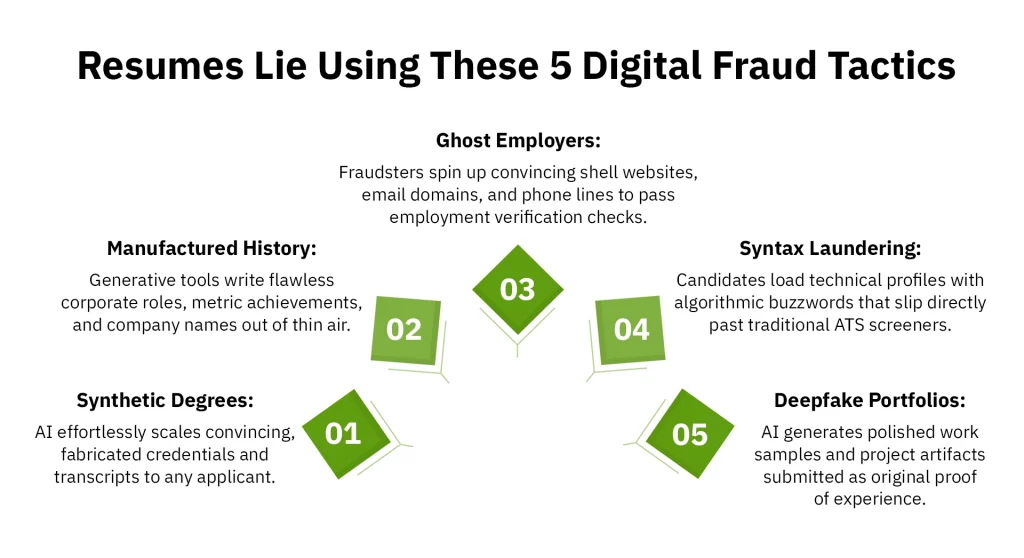
5 Common Resume Inflation and Fraud Tactics Recruiters Are Missing in 2026
These aren’t edge cases. They range from everyday resume inflation to outright fabrication, and they’re making it through to offer stage right now.
1. Degree fabrication
AI generates certificates and transcripts that look convincing at a glance. Fake credentials used to require specialist forums. Now they’re scalable to anyone with an internet connection.
2. Employment history manufacturing
AI builds plausible job descriptions for roles the candidate never held, complete with company names, metrics, and accomplishments tailored to the exact target role.
3. Reference spoofing
Candidates build scripted fake reference personas. Multiple recruiters in 2025 reported completing verification calls with AI voice tools running the other side of the conversation.
4. Skills laundering
Technical skills a candidate doesn’t have get listed in the exact syntax that passes AI-based screeners. The gap surfaces on day 45, not day 0.
5. Identity fraud at scale
The FBI has documented multiple North Korean state-sponsored schemes placing operatives as remote workers using stolen American identities. In 2025, the US Department of Justice unsealed indictments against a network embedded inside over 300 US companies, many sourced through staffing intermediaries. In early 2026, a coordinated fraud ring operating across European and North American recruiting platforms was dismantled after placing fabricated candidates in financial services roles across six countries.
Getting fooled by a convincing PDF is no longer a recruiter error. It’s a systems failure. And the question of what recruiters can actually trust when AI writes the resume has gone from theoretical to urgent.
The Liability Nobody Is Putting a Number On
HR analyst Ben Eubanks has written that the resume lies recruiters fail to catch create a second wave of damage: negligent hiring claims, regulatory exposure, and breached client contracts, particularly in healthcare, finance, and government-adjacent roles.
A 2025 Gartner survey on workforce risk identified credential fraud as a top-five liability in contingent hiring, with staffing agencies flagged as elevated-risk intermediaries. They absorb the reputational fallout when a placed candidate’s background unravels.
Recruiters burning through six figures on a fraudulent placement aren’t making a judgment call that went sideways. They’re running a process that was never designed to catch this.
That’s a hiring intelligence layer missing from the process. And it’s one a complete picture of what candidates fake, how it gets through, and how agencies stop it makes impossible to ignore.
Candidate Seems Great" Is the Most Expensive Phrase in Recruiting
The most dangerous resume lies recruiters face are the most polished. They’ve been built by AI to pass every trust signal: the resume arc, the performance language, the career narrative. That polish is the output of the same tools being used to evaluate them.
The AI tools that promised to fix recruiting didn’t account for candidates using them offensively. Firms still running gut-feel shortlists are more exposed than they were two years ago.
Every shortlist going to a client needs to be verified before it’s reasoned about. Presentation is not evidence, and without a hiring intelligence layer in the loop, no one is checking. Getting catfished by a beautifully formatted document is now a documented, repeatable attack on the hiring pipeline.
Key Takeaways
- Resume inflation and resume fraud now sit on the same spectrum.
- AI didn’t invent resume fraud, it industrialized it.
- Generative tools can reverse-engineer a job description and produce a document that clears ATS screening and reads as fully credible, with no real experience behind it.
- A polished resume is not proof. The same AI tools recruiters rely on to source candidates are being used against them, which means presentation-based screening is no longer a safe filter.
- The fix isn’t more scrutiny from tired recruiters; it’s a hiring intelligence layer.
- A verification step built into the process that checks candidates before a shortlist ever reaches a client.
Final Thoughts
The common resume lies recruiters encounter in 2026 weren’t written by a nervous candidate stretching the truth. They were generated in seconds, by a tool that produces a convincing career history out of nothing.
The question isn’t whether resume fraud is happening. It’s whether the hiring process in use today was built to catch it. Most weren’t. They were designed for a pre-AI era when fabricating a career required real effort. The candidates gaming the system right now aren’t cutting corners. They’re using professional-grade tools. And they’re winning hiring decisions because the verification layer simply isn’t there to stop them.
Frequently Asked Questions (FAQs)
1. Can recruiting teams tell the difference between resume inflation and outright resume fraud during screening?
No, resume inflation and resume fraud often look identical until a hiring intelligence layer verifies specifics.
2. Should staffing agencies treat resume inflation as a security risk rather than a minor exaggeration?
Yes, unchecked resume inflation can escalate into resume fraud with real security and liability consequences.
3. Do talent acquisition teams need a hiring intelligence layer to catch AI-generated resume inflation?
Yes, a hiring intelligence layer flags AI-generated resume inflation that standard screening tools miss entirely.
4. Can hiring teams rely on ATS scoring alone to detect resume inflation?
No, ATS scoring rewards polish, so resume inflation and resume fraud pass through undetected.
5. Is resume fraud becoming more common than simple resume inflation among staffing agency candidates?
Yes, resume fraud is rising fast, but resume inflation remains the more frequent everyday problem.
6. Should recruiters verify credentials even when resume inflation seems minor?
Yes, small resume inflation can mask larger resume fraud, so recruiters should verify every credential.
7. Can a hiring intelligence layer help recruiting teams reduce liability from resume fraud placements?
Yes, a hiring intelligence layer reduces liability by catching resume fraud before candidates reach clients.
8. Do talent acquisition teams face legal exposure from undetected resume inflation?
Yes, undetected resume inflation and resume fraud create negligent hiring and regulatory exposure for agencies.