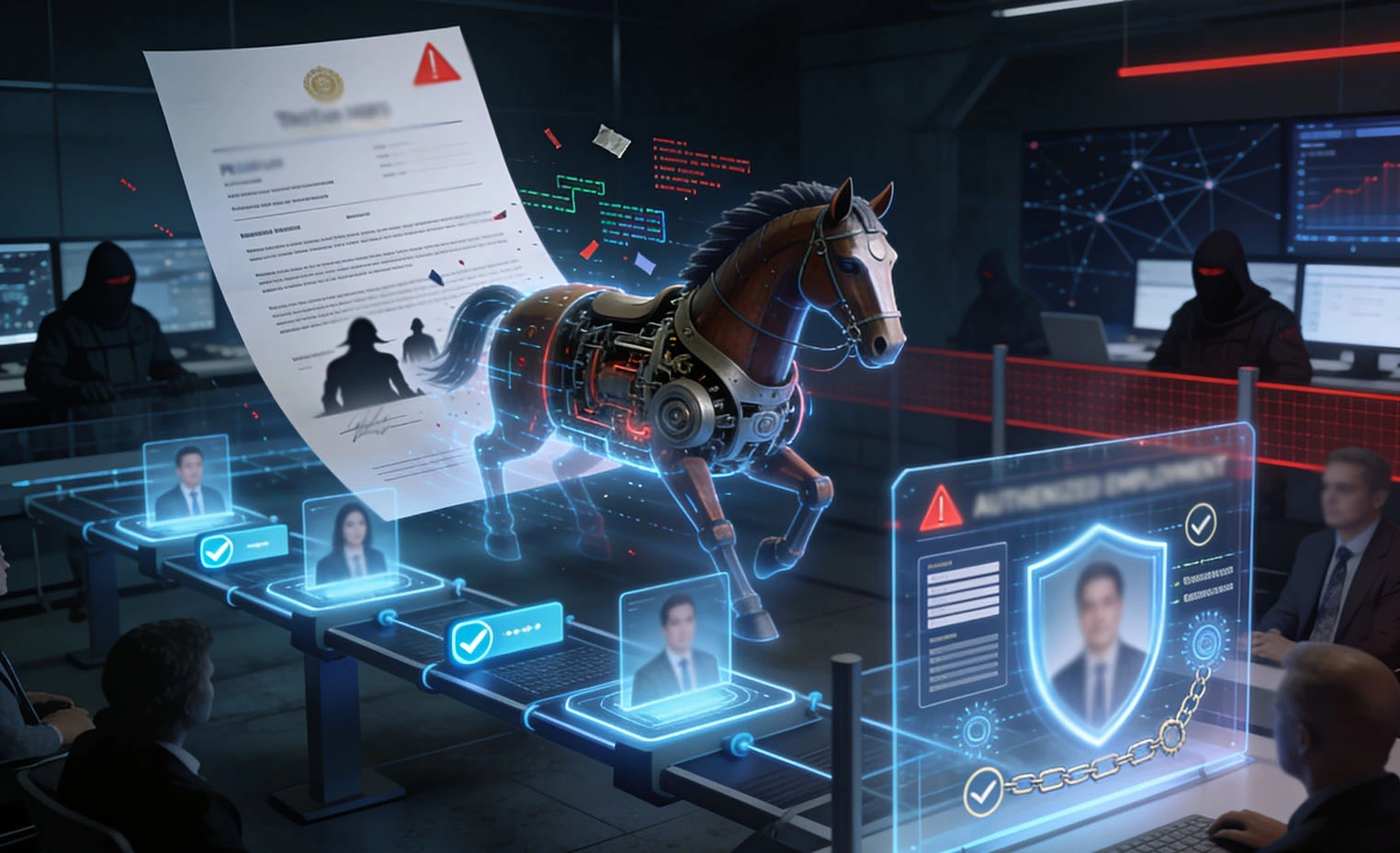

He passed every screen. Aced the interview. Came with glowing references.
Then the background check came back clean too. Because he built it that way.
The degree? Fabricated. The five years at a Fortune 500? A company that never existed. The references? His college roommates, prepped and ready. Three months in, the client called. The work was garbage. Hire was gone. The bill? Just over $85,000.
That wasn’t bad luck. That was a resume that lied perfectly. And a recruiting process that never once asked it to prove itself.
This is happening in your pipeline right now. Probably more than once.
Lying on a Resume Used to Take Effort. Now It Takes a Prompt.
Remember when resume fraud meant rounding up a GPA or fudging a job title?
Those were the innocent days.
Today, a candidate opens an AI tool, pastes your job description, and gets back a perfectly tailored work history. Complete with achievements. Metrics. Consistent dates. Keywords that crack your ATS right open.
SHRM’s 2025 Talent Acquisition Report found that 85% of HR professionals encountered resume fraud in the past year. Forbes flagged that AI-generated resumes are now nearly impossible to distinguish from real ones without active verification checks.
Josh Bersin called it straight in early 2025: “The biggest threat to hiring quality right now is not a bad candidate. It is a convincing one.”
That conviction does not come from hustle or charisma anymore. It comes from a $20 AI subscription and 20 minutes of free time.
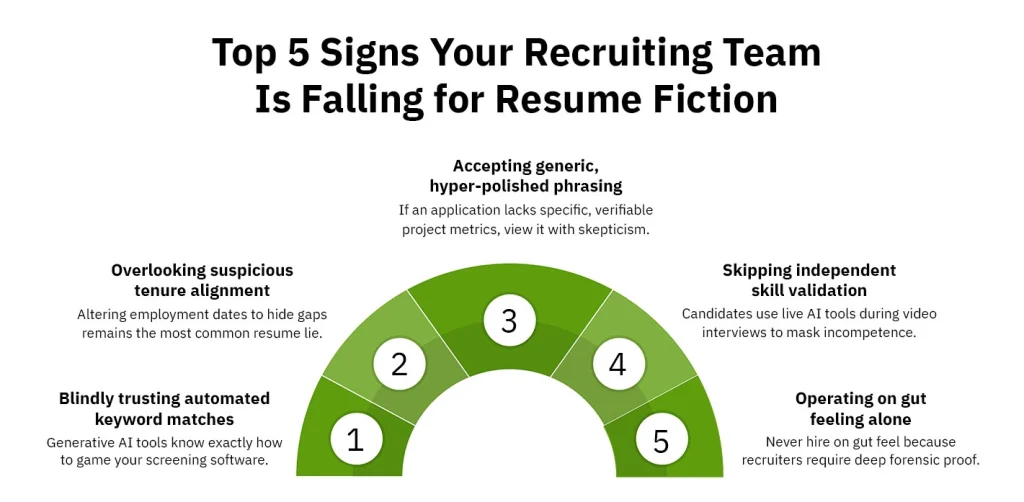
Your recruiters were not trained for this. Most of them are still reading resumes the same way they did in 2018. And the candidates who are lying know exactly what that means for them.
Wait Until You Hear What North Korean Hackers Are Doing to Staffing Firms Right Now
This is the part that keeps compliance teams up at night.
Since 2024, the FBI and the U.S. Department of Justice have been issuing escalating alerts. North Korean IT operatives are applying to remote jobs in North America under stolen or fully fabricated American identities. By 2026, the targets are no longer just Big Tech. They are mid-market companies, staffing agencies, and their clients.
These are not clumsy attempts. These operatives build full digital identities. AI-generated headshots. Polished LinkedIn profiles. Voice-altering software for remote interviews. Some stayed employed for months before anyone noticed.
The New York Times reported in 2026 that multiple staffing firms unknowingly placed these operatives inside client organizations. The legal and reputational fallout was severe.
Ben Eubanks, Chief Research Officer at Lighthouse Research and Advisory, put it bluntly in 2025: “Most recruiting teams are running on trust-based systems designed for a world that no longer exists.”
Your shortlist process was built for candidates who occasionally stretched the truth. Not for nation-state-level identity fraud. Those are two completely different problems. And right now, you only have a solution for one of them.
If you want to understand what a truly bulletproof shortlist looks like, this is where to start.
The 5 Things on a Resume That Should Make Your Recruiter Stop Cold
Flag these. Every time. No exceptions.
1. Employment dates that conveniently align but never overlap with any verifiable records
Fabricated employers are easy to invent and hard to catch without a deliberate check. If a company cannot be confirmed independently, treat it as a red flag until proven otherwise.
2. A skills section that mirrors your job description almost word for word
AI-generated resumes are optimized to beat ATS filters. A resume that echoes your exact posting is not impressive. It is suspicious.
3. References who only have personal email addresses
Legitimate professional references have corporate emails. Personal-only contacts are one of the most common signals in verified fraud cases.
4. Degrees from real institutions with no enrollment record
Credential inflation is the number one form of resume fraud globally, according to SHRM’s 2025 data. A prestigious school name means nothing without a confirming record.
5. A LinkedIn profile that was created within 90 days of the application date
A brand-new profile with a rich, detailed history does not add up. It is a common hallmark of a constructed identity.
A Good-Looking Resume Is Not Evidence of Anything
Here is the thing recruiters rarely say out loud: resumes were never proof. They were always pitches.
The difference is that now AI has made the pitch flawless. No typos. No gaps. And no inconsistencies. Nothing to catch.
Gartner flagged in 2025 that synthetic candidate profiles would account for a rising share of enterprise hiring pipelines by 2026. That number is not shrinking.
The frustration recruiters already feel about AI in hiring is real and it is justified. The tools that promised to make their jobs easier are now arming the people trying to game the system.
And the next wave is coming. When AI writes the entire resume from scratch, what does a recruiter even trust?
The number that gets buried in this conversation is the cost.
Josh Bersin’s 2025 research puts a mid-level bad hire at 1.5x to 3x annual salary when you factor in onboarding, lost productivity, team disruption, and replacement costs. For staffing firms, add client attrition and contract penalties on top.
Here is exactly what that damage looks like. And if you want to understand the full toxic fallout a single bad hire leaves behind, this one does not pull punches.
The math is not complicated. One fraudulent hire undoes months of recruiting work and budget. The question is whether your process is designed to stop it.
Octagnt Does Not Trust Resumes. It Tests Them.
Most verification tools do a surface check. They confirm a name, run a database ping, and call it done.
Octagnt goes deeper. It is an evidence layer for hiring built for exactly the environment recruiters are operating in today. It cross-checks employment history against real company records. It flags credential inconsistencies. It surfaces identity mismatches before a candidate ever reaches your interview stage.
The question used to be “Does this candidate look right?”
Forensic hiring asks a better one: “Can you prove it?”
Octagnt answers that question. Every time. Before the offer goes out.
Key Takeaways
- AI tools now let anyone fake a flawless work history in under 20 minutes
- Resume fraud has hit record highs across North American hiring markets in 2025-2026
- State-sponsored operatives including North Korean hackers have infiltrated staffing firms and their clients
- The cost of one fraudulent hire runs 1.5x to 3x annual salary, per Josh Bersin’s 2025 research
- Octagnt is the evidence layer for hiring that stops resume fiction before it costs you
Final Thoughts
The resume sitting in your inbox right now might be completely real. It might also have been built in 20 minutes by someone who has never done the job they are claiming.
You cannot tell the difference by reading it harder.
The firms that protect their clients, their margins, and their reputation in 2026 are the ones that stopped trusting pretty PDFs and started demanding proof. Octagnt is how they do it.
Stop falling for resume fiction. Start hiring on truth. Try one role for free.
Frequently Asked Questions (FAQs)
Q1. Can a recruiter really tell the difference between an AI-generated resume and a genuine one?
No. AI-generated resumes are now indistinguishable from real ones without active, structured verification checks.
Q2. Should hiring managers still trust resumes as the primary screening tool in 2026?
No. Resumes are marketing documents. Hiring managers need verified proof, not polished narratives, to make safe decisions.
Q3. Is a staffing agency legally exposed if it unknowingly places a fraudulent candidate with a client?
Yes. Staffing agencies face significant legal liability and client contract penalties when fraudulent placements go undetected.
Q4. Can a recruiting team catch credential fraud without slowing down the entire hiring process?
Yes. Structured verification layers catch fake degrees and inflated titles fast, without creating bottlenecks in your pipeline.
Q5. Does resume fraud actually cost talent acquisition specialists more than just a bad hire?
Yes. Fraud-driven bad hires cost 1.5x to 3x annual salary once onboarding, disruption, and replacement are factored in.
Q6. Should a talent acquisition specialist treat a LinkedIn profile created within 90 days as a red flag?
Yes. A freshly created profile with a rich history is a common signal of a constructed candidate identity.
Q7. Can recruiting firms protect their client relationships when candidate fraud reaches the interview stage undetected?
No. Undetected fraud damages client trust, triggers contract reviews, and puts your firm’s reputation permanently at risk.
Q8. Is it realistic for a hiring manager to verify employment history without relying on candidate-provided references?
Yes. Independent employment verification against actual company records eliminates the risk of coached or fabricated reference networks.