
Summary
Polished resumes can hide serious fraud. Discover the fraudulent resume warning signs recruiters miss until it is too late.
1 resume. 30 minutes. Zero real experience. That is all it takes to fool most recruiting teams right now, and the one sitting in your inbox today might be exactly that.
A recruiter opens a fresh resume on a Tuesday morning. The formatting is clean, the keywords line up perfectly with the job post, and the candidate’s timeline reads like a case study in career growth. Nothing looks wrong. That is exactly the problem. Because AI that promised to transform recruiting has also made it dramatically easier to fabricate a convincing one.
Without a hiring intelligence platform doing the verification work, most of these red flags never surface until it’s too late.
How to Spot a Fake Resume Before It Reaches the ATS
Most companies still lean on their applicant tracking system (ATS) as a first line of defense. That is a mistake. ATS technology filters and ranks resumes by keywords. It was never built to verify identity, employment history, or credentials. That structural gap means resume fraud sails right through the filter and lands on a recruiter’s desk looking legitimate.
Catching resume fraud has to start at the application stage, before the ATS ever touches the file. Your team does not need a filter. It needs forensic-level proof that a candidate is who they say they are. And what a fast, verified, and reasoned shortlist actually looks like is a higher bar than most recruiting processes currently reach.
Long-running background screening surveys from firms like HireRight, CareerBuilder, ResumeLab, and StandOutCV have consistently found that a large majority of job seekers — commonly cited above 70% across these surveys — admit to lying or exaggerating somewhere on a resume.
That is not a fringe problem. It is baked into the hiring pipeline. For a fuller breakdown, see the complete guide to resume lies: what candidates fake, how it gets through, and how staffing agencies stop it — and the 2026 resume fraud statistics that should make you’re think your last five hires.
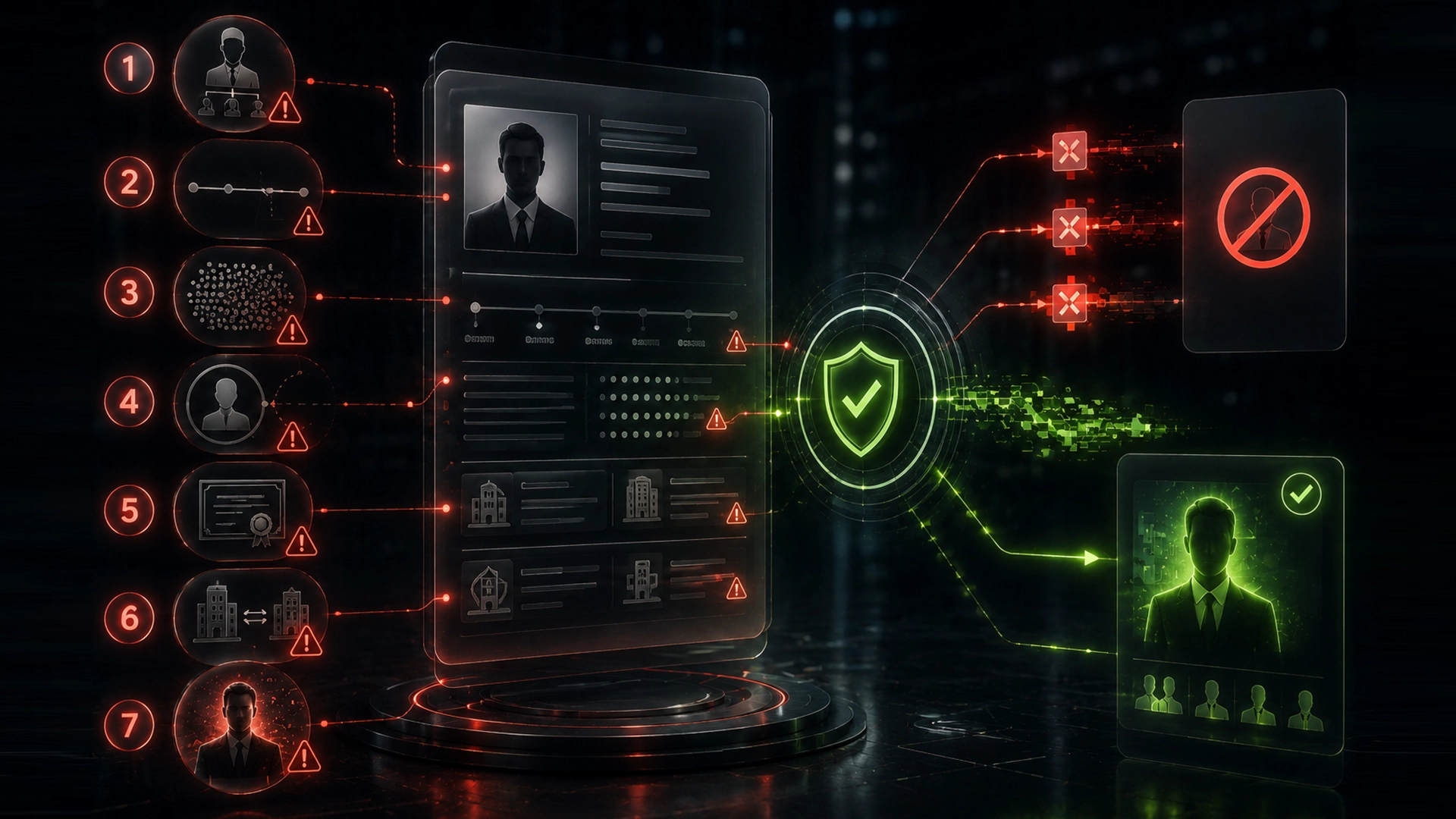
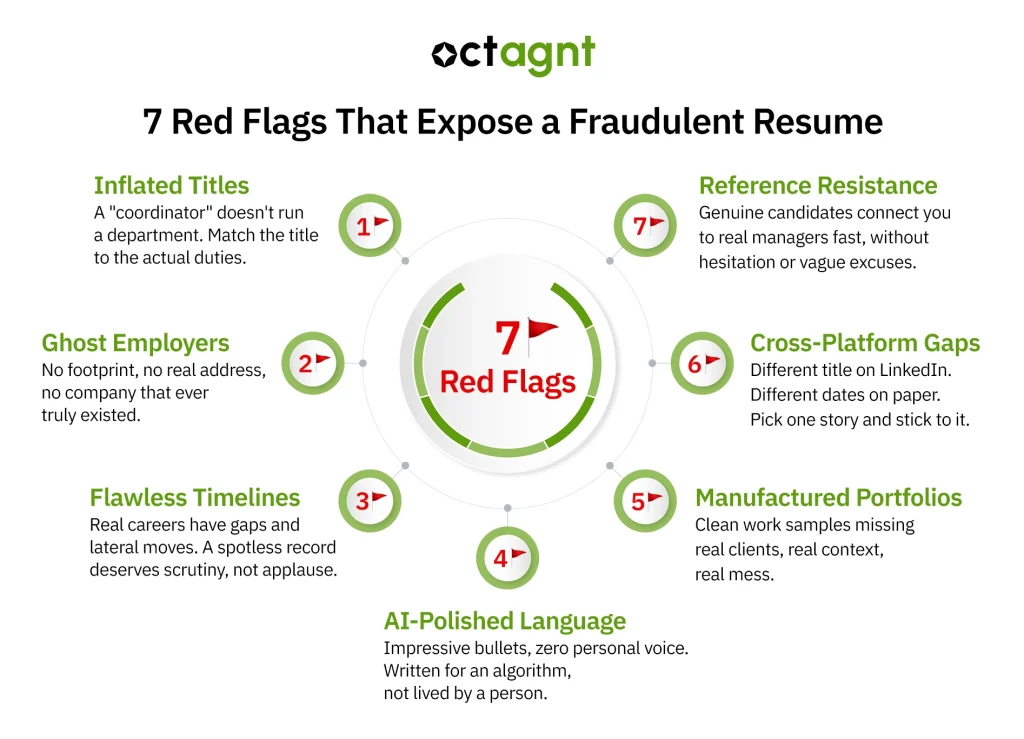
7 Red Flags That Expose a Fraudulent Resume
1. Job Titles That Don’t Match Reality
Candidates inflate titles to sound senior. A “coordinator” becomes a “manager.” A “junior analyst” becomes a “director of strategy.” Cross-check the title against the scope of duties listed. If the responsibilities do not match the seniority implied, that mismatch is one of the clearest fraudulent resume warning signs recruiters run into. Where resume inflation ends and an outright lie begins is a line worth understanding before your next screening round.
2. Unverifiable Companies or Addresses
Fake work history red flags often hide in plain sight: a company with no digital footprint, a headquarters address that maps to a residential building, or a business that dissolved years before the listed employment dates. This is not confined to one sector — the industries where resume fraud is most rampant will surprise most recruiters, and the patterns shift based on where verification gaps are largest.
3. Suspiciously Perfect Timelines
Real careers have friction. Gaps, lateral moves, short stints. A timeline with zero gaps and steady upward movement — especially across a volatile industry — deserves a second look. What it costs when a recruiter trusts a polished timeline at face value is a number most hiring teams have never actually calculated — and would not like if they did.
4. Overly Polished Language With No Personal Voice
AI-generated bullet points tend to sound impressive but generic. Watch for language that reads like it was optimized for a job description rather than written by someone describing their own work. This is one of the more subtle fraudulent resume warning signs because it hides behind good grammar. The good news is that AI is now catching resume liars in minutes — and understanding how it works will sharpen what your screening process should flag.
5. Portfolio Pieces That Feel Generic
Simulated work samples are now easy to produce. A portfolio piece that lacks specific context, client names, or messy real-world detail may be manufactured rather than lived experience. Recruiters are being catfished by pretty PDFs every week — and the problem is compounding as generative tools improve and output becomes indistinguishable from the real thing at a glance.
6. Inconsistent Details Across Platforms
Compare the resume against LinkedIn, portfolio sites, and any public record. Different job titles, different dates, or a skill set that appears on one platform and not another are classic fraud signals. How resumes lie in the age of AI — and how recruiters are getting fooled every week — goes deeper on these cross-platform inconsistency patterns if this shows up in your current stack.
7. Reluctance to Provide Verifiable References
Genuine candidates are usually comfortable connecting a recruiter with former managers. Hesitation, vague answers about how to reach a reference, or references that turn out to be friends posing as supervisors are strong signals of candidate fraud. The scale of the toxic fallout a single fraudulent hire can cause makes clear why this flag cannot be skipped. Pair it with every other resume red flag your team must catch before the first call costs them a client — and treat the combination as non-negotiable.
Top 5 Places Fraud Hides on a Resume
Not all resume fraud is created equal. Some lies are detectable in 30 seconds. These are the five zones where fraud concentrates and where verification effort pays back fastest.
1. Job Titles and Seniority Claims
Title inflation is the most common form of resume fraud because it is also the easiest to miss. Candidates know that titles carry weight in ATS scoring, so they upgrade them to match whatever keyword cluster a job description uses. A “coordinator” becomes a “manager.” A “team contributor” becomes a “director of strategy.” The mismatch almost never shows in the title itself — it appears in the gap between the listed title and the listed duties.
The fastest check: ask directly about team size managed, budget owned, and decision-making authority. Inflated titles collapse within two focused questions. Cross-referencing against LinkedIn job history exposes further mismatches, especially when a candidate’s public profile tells a different seniority story than the resume does.
2. Employment Dates and Gaps
Date fraud is subtler but widespread. Candidates extend the end date of one role to eliminate the visible gap before the next. A six-month gap becomes seamless with a few adjusted months. Others overlap roles held sequentially to appear more experienced, or to obscure a termination that would raise questions.
Employment date fraud is hard to catch on a visual scan but straightforward to expose with a direct verification request to the employer of record. When dates shift between the resume and LinkedIn — even by a single month — that inconsistency is almost never accidental. It is the edit that covers the gap.
3. Company Names and Locations
Employer fraud goes further than listing companies that never existed. Candidates name real companies but inflate their relevance: they list a global headquarters rather than the small regional branch where they actually worked, or name a well-known parent company instead of the subsidiary. Some exploit defunct businesses, knowing that verification is difficult when the employer no longer operates.
A quick search for the business registration address — cross-checked against the candidate’s claimed city, role, and employment dates — catches a large share of this. This pattern of employer inflation often runs alongside credential fraud; knowing how to spot a fake degree before making a client submission covers the overlap in detail.
4. Certifications and Degrees
Credential fraud is the most consequential type and among the hardest to spot on a scan. Candidates list certifications that expired, degrees that were never completed, or institutions that sound legitimate but are unaccredited diploma mills. Some go further and purchase fraudulent credentials from paper mills that issue certificates with official-looking seals.
For client-facing, licensed, or compliance-sensitive roles, unverified credentials create legal exposure as well as performance risk. When AI writes the resume, it becomes even easier to dress fabricated credentials in convincing surrounding language — making visual inspection alone an increasingly unreliable filter.
5. Portfolio Links and Work Samples
AI has made this category a minefield. Work samples that once required months of real client experience can now be assembled overnight. A portfolio that looks polished and specific may have been generated in 30 minutes with the right prompts. The tell is context: genuine work has friction. A real portfolio references actual client constraints, shows revision history, and can be traced back to identifiable projects. Fabricated samples tend to be technically impressive but contextually hollow.
Push for specifics in the screening call. Ask who the client was, what the brief said, and what changed between the first draft and the final version. Candidates who cannot answer those questions in concrete detail rarely worked on the project at all.
Resume misrepresentation clusters precisely where it is hardest to notice at a glance. It also clusters where verification gets skipped because there is no time — which is why burying your recruiting team in verification admin without the right tooling is a problem as real as the fraud itself.
Key Takeaways
- Polish is not proof. AI has made it easy to produce a resume that looks credible without being accurate.
- ATS was built for filtering, not fraud detection. Verification has to happen before that stage.
- A large majority of job seekers admit to some form of resume embellishment, according to long-running industry surveys.
- The seven red flags above cover the most common patterns behind resume fraud today.
- Verification at the application stage — not after the first call — is what actually protects hiring decisions.
Final Thoughts
Resume fraud is not a new problem. What is new is how invisible it has become.
A decade ago, a polished resume indicated effort. Today it indicates access — access to an AI writing tool, a prompt library, or a content generator that can produce a convincing career narrative in 30 minutes flat. The same signals that once separated a prepared candidate from an unprepared one have been neutralized. Formatting, keywords, action verbs, structured summaries — all of it can be manufactured. What cannot be manufactured is verified truth.
Systematic verification does not rely on memory or bandwidth. It runs at the application stage — before a single calendar invite goes out, before a client name is attached to the candidate, and before your team’s credibility is on the line.
That is what Octagnt is built for. Try one role for free now.
Frequently Asked Questions (FAQs)
1. How do recruiters know when a resume misrepresentation has occurred during screening?
Recruiters spot resume misrepresentation by checking job titles, employment dates, and companies against public and verified records very carefully.
2. Can hiring managers rely on ATS software to catch resume fraud automatically?
No, hiring managers cannot rely on ATS software, since it only filters keywords and was never built to verify claims.
3. Is candidate fraud becoming more common because of accessible AI writing tools?
Yes, candidate fraud has grown more common as AI tools make polished, convincing, keyword-optimized resumes instantly available to nearly anyone.
4. Should TA specialists verify employment dates even when a resume looks completely legitimate?
Yes, TA specialists should verify employment dates regardless of appearance, since polished formatting has absolutely no connection to factual accuracy.
5. Can a fake resume pass through multiple interview rounds without detection?
Yes, a fake resume can pass multiple rounds when verification only happens after interviews rather than at the application stage.
6. Do recruiters typically catch resume fraud before or after making an offer?
No, recruiters typically catch resume fraud after the offer stage, which is usually far too late to prevent hiring damage.
7. Should staffing agencies flag candidates who resist providing verifiable references?
Yes, staffing agencies should flag reference resistance immediately, since it very often signals deeper resume fraud or fabricated employment history.