

A fake degree verification failure rarely announces itself. It shows up later, as a client call nobody wants to take.
The recruiter had done everything right. The resume was clean. The degree from a state university looked legitimate at first glance. Three rounds of interviews, strong feedback from the client, no red flags anywhere in the notes. The candidate started on a Monday. By Wednesday, the client’s security team flagged anomalies in the employee’s system access patterns. By Friday, the investigation was done. The graduate degree? Fabricated. The employment history? Stitched together using AI tools designed to generate convincing professional timelines. The references held up on the call because they’d been coached, line by line, by the same toolset.
The recruiter lost the placement fee, the retainer, and the client relationship. All of it. In one week.
Why Fake Degree Verification Can't Be an Afterthought
Resume fraud has existed as long as resumes have. But something shifted when generative AI arrived. The problem didn’t just grow in volume. It upgraded in sophistication. What used to require a forger and a printer now requires a laptop and fifteen minutes.
Recruiters and HR leaders who think they’re screening candidates are, in many cases, screening AI-assisted presentations of candidates. That’s a different problem entirely.
This is why fake degree verification and education verification in hiring have moved from best practice to survival skill.
Resume Inflation vs. Fabrication: Know the Difference
Not every misrepresentation is the same offense. Understanding where the line sits between resume inflation and outright fabrication is the first step toward knowing what to verify and what to weigh.
Resume inflation is a candidate stretching a six-month engagement into “a year of experience.” It’s common, it’s problematic, and it’s been part of hiring for decades. Fabrication is an entirely different category. It’s a candidate inventing an MBA from an institution they never attended. Inventing a job title they never held. Inventing a degree that was never conferred.
AI didn’t create the liar. It gave the liar a production studio.
How AI Turned a Manageable Problem into a Crisis
HR analyst Josh Bersin noted in early 2026 that AI adoption among job seekers has significantly outpaced the screening technology recruiters rely on. Candidates upgraded their tools faster than the firms evaluating them did. The result is a gap that fraud exploits daily.
Generative AI can build a convincing degree transcript, a fabricated education history, and a scripted reference narrative in under an hour. That dynamic is something recruiting teams are starting to feel as a direct betrayal. The technology they expected to help them is now arming the other side.
The question of what recruiters can actually trust when AI is the one writing the resume is one the industry hasn’t resolved. When candidates arrive with convincing document fiction packaged as polished PDFs, the screening process fails before it starts.
The North Korea Wake-Up Call
In 2025 and into 2026, the FBI and Department of Justice confirmed dozens of active cases where North Korean state-sponsored operatives had obtained remote IT positions at US companies using fabricated identities, AI-generated credentials, and stolen personal information. The Financial Times reported on the scale of the operation and the near-impossibility of detecting operatives using standard document review, because their documentation was built to pass it.
This is not a geopolitical issue for staffing firms. It is a liability issue. A recruiting agency that submits a compromised candidate to a financial services, healthcare, or defense-adjacent client is exposed. The fallout from a single bad placement reaching a client is a cost most firms don’t fully calculate until they’re inside it.
In 2026, a separate major case involving fabricated healthcare credentials at a UK-based organization was covered by the Financial Times, reinforcing that credential fraud is not industry-specific and not geography-specific. It scales wherever verification doesn’t.
5 Red Flags Recruiters Are Missing Right Now
Most credential fraud doesn’t fail a gut check. It fails a process check. These are the five signals that consistently surface in cases where a fabricated degree made it through to a client submission.
1. Graduation Dates That Don’t Align With Early Career Timelines
A 2018 degree next to a 2015 senior role is a contradiction, not a quirk. If the education doesn’t support the early career claims, the submission shouldn’t move forward.
2. Degrees From Institutions That Closed, Merged, or Rebranded
Diploma mills exploit dead registrars. If there’s no active institution to verify against, that’s not a paperwork problem. That’s the answer.
3. Education Sections Edited Recently in Online Career Portals
A profile education update made 60 to 90 days before application, timed close to the job posting, is a data point. It takes 90 seconds to check. Almost nobody checks.
4. References Who Answer Too Fast and Sound Too Prepared
Real references hesitate. They forget dates. AI-coached ones don’t. Push for a specific detail that wasn’t in the prep script and watch the answer fall apart.
5. Certifications That Don’t Appear in Issuing Body Databases
Every credible certification has a public registry. Ask for the credential ID before submission. A legitimate holder produces it in under a minute. Delay is the tell.
Spotting these takes bandwidth that most teams don’t have. HR analyst Ben Eubanks has pointed out that recruiting teams are often so buried in administrative process that the judgment-intensive work gets crowded out. Forensic credential review doesn’t happen inside an overloaded workflow. A deeper look at which industries see the highest rates of credential fabrication makes clear this isn’t a niche problem confined to tech or finance.
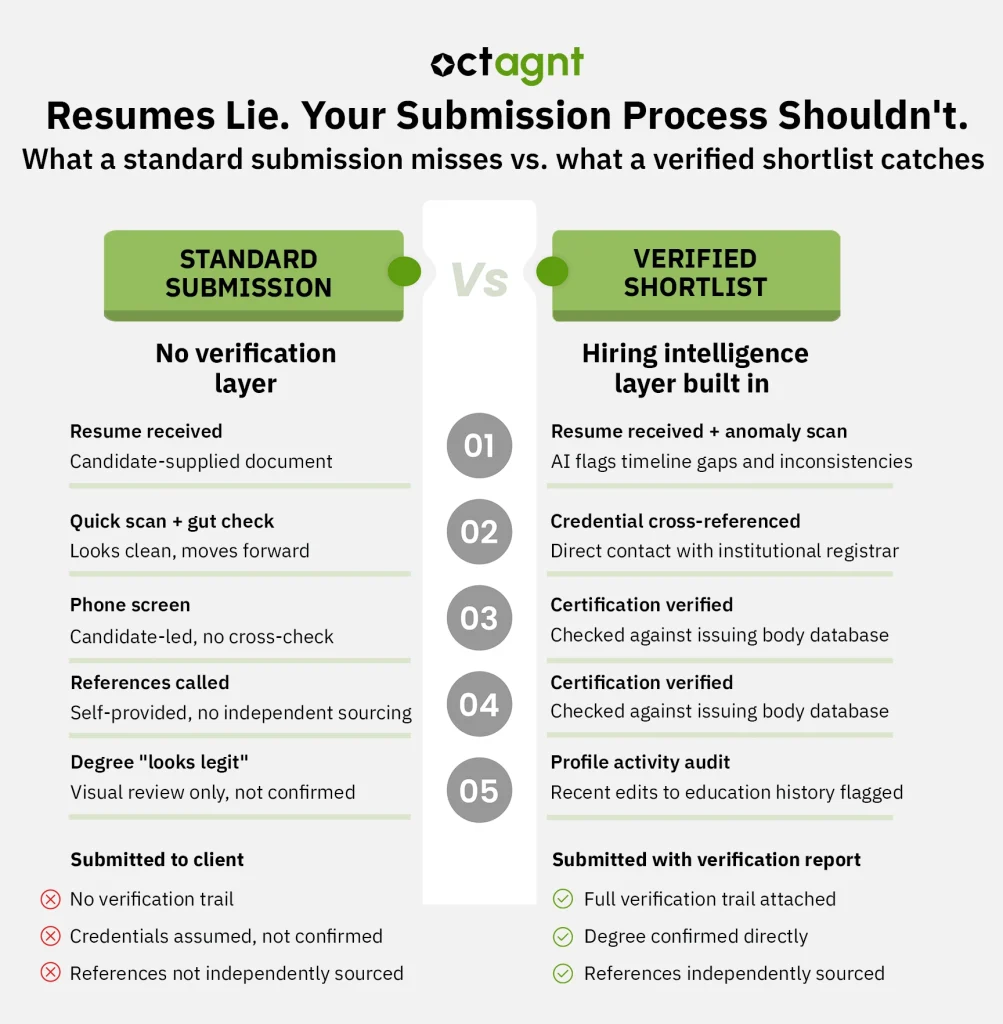
What Education Verification in Hiring Actually Requires
Standard background checks were built to surface criminal history. They were not built to catch a fabricated degree PDF designed using the same tools a university communications team uses for official documents.
Real fake degree verification means going directly to institutional registrars, cross-referencing with national credential databases, and using candidate verification software that doesn’t rely on document appearance. A hiring intelligence layer built into the submission process changes what a shortlist actually means and what it’s worth to the client receiving it.
“Candidate seems great” stopped being a strategy the moment AI entered the candidate toolkit. Forensic proof is what replaces instinct at this stage of the market. The firms that make that shift stop discovering problems on a Thursday afternoon after the client calls. The ones that don’t are absorbing losses on every submission that slips through, and most of them don’t track those losses precisely enough to know the total.
Key Takeaways
- AI has made credential fabrication faster, cheaper, and visually indistinguishable from legitimate documentation
- Resume inflation and fabrication are categorically different; the verification response to each should be different too
- North Korean state-sponsored operatives are actively inside remote hiring pipelines using AI-generated credentials
- Education verification in hiring requires direct institutional confirmation. Document review is no longer sufficient
- Candidate verification software deployed as a hiring intelligence layer is now a baseline requirement for responsible submissions
Final Thoughts
Fake degree verification isn’t a compliance step. It’s a business protection mechanism. Every submission that goes out without verified credentials is a liability walking toward a client. The staffing firms and HR leaders who build education verification into every submission workflow don’t just protect their clients. They protect their placements, their retainers, and their ability to grow in a market where one bad hire reported publicly is enough to redefine a firm’s reputation.
The tools exist. The standard is clear. The only question is whether the process catches up before the next Thursday call.
Frequently Asked Questions (FAQs)
Q1. Can staffing agencies rely on background checks alone for fake degree verification?
No. Background checks surface criminal history only. Education verification in hiring requires direct registrar confirmation, not document review.
Q2. Should recruiting teams verify a candidate’s degree before making a client submission?
Yes. Every submission without verified credentials is a liability. Fake degree verification must happen before the placement, not after.
Q3. Can AI-generated credentials fool hiring teams conducting standard education verification checks?
Yes. Generative AI produces convincing transcripts indistinguishable from real documents, making standard education verification in hiring dangerously insufficient.
Q4. Does candidate verification software help recruiters detect fabricated degrees more accurately?
Yes. Candidate verification software cross-references institutional databases directly, catching fabrications that visual document review consistently misses.
Q5. Are talent acquisition teams at legal risk if they submit a candidate with a fabricated degree?
Yes. Staffing agencies exposing clients to compromised candidates face direct legal and financial liability, regardless of intent.
Q6. Is education verification in hiring more critical now for recruiting teams than it was five years ago?
Yes. AI has made credential fabrication faster and undetectable, making education verification in hiring non-negotiable for every talent acquisition team.
Q7. Should hiring teams treat polished, near-identical reference answers as a positive signal?
No. Recruiting teams should treat identical, polished answers as a fabrication signal. AI-coached references sound consistent by design.
Q8. Do staffing agencies lose client relationships when a fraudulent candidate clears their screening?
Yes. Placement fee, retainer, and client relationships are all at risk when fake degree verification fails before submission.