

The email from your newly hired lead DevOps engineer arrived at 6:15 AM on a Tuesday. It did not contain the codebase update you expected. Instead, it was an extortion demand. The developer your team spent three weeks vetting, interviewing, and onboarding was not an elite engineer from Austin, Texas. He was a state-sponsored threat actor operating out of East Asia, utilizing a US-based laptop farm and real-time AI face-swapping software. By the time your security team cut his remote access, your intellectual property was already exfiltrated.
This sounds like a Hollywood tech-thriller. In 2026, it is just another Tuesday in corporate talent acquisition.
Recruiting firms, staffing agencies, and enterprise HR departments are under siege. Yet, leadership continues to treat recruiters like glorified data entry clerks. We bury brilliant human capital professionals under a mountain of administrative rubble. They spend half of their day manually cross-referencing online career profiles, formatting resumes, and chasing ghost references. Meanwhile, sophisticated fraudsters are driving an 18-wheeler right through the front door of your hiring funnel.
Resumes Don't Just Lie Anymore. They Lie With a Portfolio and a Fake Reference Stack.
Resumes have always stretched the truth. That is not new. What is new is the scale, the speed, and the sophistication.
In 2026, generating a polished, ATS-optimized resume takes under five minutes. AI tools are free, widely available, and frankly, very good. Anyone can manufacture a career history that reads like 10 years of senior experience. Complete with project names. Measurable outcomes. Certifications that look completely legitimate.
Forbes reported in Q1 2026 that nearly 1 in 3 candidates now use generative AI tools to significantly alter or fabricate resume content. Not embellish. Fabricate.
Ben Eubanks, Chief Research Officer at Lighthouse Research & Advisory, called AI-assisted resume fraud “the single most underestimated compliance risk in talent acquisition right now.”
He is right. And the North Korean IT worker infiltration scheme proves it at scale. These were not sloppy attempts. They passed standard screening at dozens of companies across multiple industries. The credentials looked real because they were built to look real.
Your team is reading those documents and making hiring decisions based on what they say. The question: what stays trustworthy once AI has authored every resume.
That One Problem Nobody Wants to Put in the Board Deck
Here is the stat that should make every staffing firm CEO uncomfortable.
According to SHRM’s 2026 Talent Operations Report, recruiters spend more than half of their working hours on administrative tasks. Not sourcing. Not building client relationships. Not strategy. Admin.
Three days out of five. Gone.
Manual data entry. Chasing references that never respond. Copy-pasting candidate profiles between systems. Credential cross-checking that takes hours and still misses things. Status update emails nobody reads.
Can Your Recruiting Team Survive the Toxic Fallout of Your Last Hiring Mistake?
You hired experienced talent acquisition professionals. And you turned them into highly paid data entry clerks.
Josh Bersin, one of the most cited researchers in HR, said it bluntly in early 2026: “Recruiters are drowning in operational work while the actual hiring decisions get made faster and with less scrutiny than ever before.”
That combination is not just frustrating. It is a liability.
Is Your Recruiter Accidentally Lighting $100K on Fire Every Time They Trust a Nice-Guy Resume?
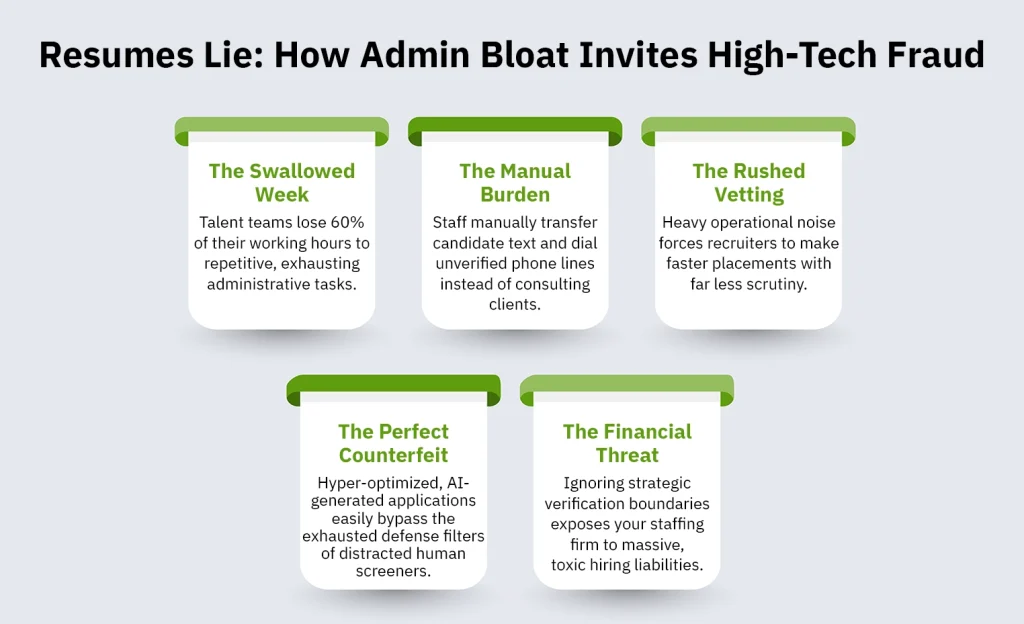
Top 5 Warning Signs Your Team Is Buried in Admin and Blind to Fraud
1. Verification takes longer than sourcing
If your team spends more time fact-checking than finding candidates, the process is already broken.
2. You had a candidate lie about credentials
That is not a human error. That is a forensic gap.
3. Your ATS is cluttered with duplicate records
Admin debt compounds. It slows every search. It hides patterns that fraud detection needs to see.
4. References are “called” but never truly verified
A phone call is a conversation. An AI-generated reference contact passes phone screens easily. It happens more than anyone admits.
5. Your recruiters feel like they are reacting, not recruiting
That is the clearest signal. When strategy disappears from their day, admin has taken over completely.
Reclaim 60% of Your Team's Wasted Time with Octagnt
You cannot solve a high-tech AI fraud problem with low-tech manual labor. Your recruiters need an automated, forensic-grade solution that strips away the administrative bloat and delivers absolute certainty.
Octagnt is the forensic engine engineered to reclaim 60% of your recruiting team’s wasted time. By automating deep data verification, cryptographic identity checks, and cross-platform history analysis, Octagnt transforms your workflow. It stops candidate fraud at the digital perimeter before a human recruiter ever opens a file.
Instead of typing data, formatting profiles, and chasing unverified references, your team can focus exclusively on what they do best: building deep client relationships, assessing cultural alignment, and closing top-tier talent. Every shortlist you deliver to a client should be fast, verified, and reasoned. Octagnt makes that possible by replacing manual data entry with rigorous, algorithmic proof.
Key Takeaways
- Recruiters waste up to 60% of their time on low-value data entry, leaving them vulnerable to sophisticated hiring scams.
- Generative AI allows candidates to instantly craft flawless, untruthful profiles that easily slip past legacy Applicant Tracking Systems (ATS).
- High-tech threats, including North Korean infiltration and deepfake identities, have made manual verification completely obsolete.
- Modern talent acquisition requires a shift from passive administrative screening to proactive forensic verification.
Final Thoughts
The best recruiters are not great because they type fast or manage spreadsheets efficiently. They are great because they read people. They navigate complexity. They make judgment calls nobody else will make.
Admin does not use those skills. Fraud exploits the gaps that admin creates.
Octagnt gives back what the process has been stealing. Not just hours. Trust. Confidence. The ability to tell a client: this candidate checks out, not just looks good.
Your team was not hired to be data entry clerks. Stop running them like they were. Try One Role for Free Today.
Frequently Asked Questions (FAQs)
Q1. Can a staffing agency realistically detect AI-generated candidate identities before they reach the interview stage?
Yes. Cryptographic identity checks and cross-platform digital footprint analysis catch fabricated candidates before a hiring manager ever meets them.
Q2. Is a recruiter’s judgment alone enough to protect their firm from sophisticated resume fraud in 2026?
No. Gut instinct misses AI-generated certifications, fabricated timelines, and deepfake reference stacks that only forensic-grade verification tools can catch.
Q3. Should a talent acquisition specialist still spend hours manually chasing references that may never be verified?
No. Automated deep verification replaces manual reference chasing entirely, freeing talent acquisition specialists to focus on strategy and client relationships.
Q4. Can a recruiting team recover hours lost to administrative tasks without adding headcount to the team?
Yes. Automating credential checks, data entry, and verification workflows reclaims up to 60% of a recruiting team’s full working day.
Q5. Do hiring managers actually receive shortlists they can trust when recruiters are buried three days a week in admin?
No. When admin consumes the majority of a recruiter’s day, shortlist quality drops and unverified candidates slip through unchecked.
Q6. Is a polished resume PDF still sufficient proof of a candidate’s qualifications for a hiring manager to act on?
No. A PDF is a designed document. Only cross-platform credential verification confirms what a candidate actually did and held.
Q7. Can a staffing agency protect client relationships from the financial fallout of a fraudulent placement?
Yes. Forensic pre-hire verification eliminates fraudulent placements at the source, protecting client trust and long-term agency revenue directly.
Q8. Should a talent acquisition leader be concerned when their team feels like they are reacting rather than recruiting?
Yes. Reactive recruiting is the clearest symptom of admin overload, and it signals that strategic hiring capacity has been completely lost.