

At 8:12 AM, a recruiter opened a resume that seemed impossible to ignore.
Top university. Strong technical skills. Clean career progression. Perfect grammar. Impressive achievements. The candidate even had an active LinkedIn profile and a polished portfolio.
By 10:00 AM, the resume had already moved to the shortlist.
Three interviews later, the truth surfaced. The profile photo was AI-generated. The employment history was heavily fabricated. The portfolio had been assembled using generative AI tools. The candidate was not who they claimed to be.
The company had already made the offer. The onboarding had already begun. By the time the fraud was confirmed, it had cost them over $120,000 in salary, onboarding investment, and the six weeks it took to restart the search.
Their ATS had flagged him as a 94% match.
The Paradox Nobody Saw Coming
AI was supposed to save hiring. Faster screens. Smarter shortlists. Less bias. More signal. The pitch was clean. The industry bought in.
Now it is paying for it.
The same AI that promised to cut through candidate noise has handed bad actors an industrial-grade fraud toolkit. AI writes the resume. It coaches the interview answer. AI generates the face on the video call. And the ATS, also powered by AI, scores it all favorably.
This is the AI Hiring Paradox. The technology meant to solve recruiting’s biggest problems has created its biggest trust crisis.
AI Just Handed Fraud a Cheat Code
Here is the problem nobody planned for. The same AI that screens resumes also writes them.
AI resume builders generate keyword-optimized, ATS-friendly profiles in minutes. A candidate with fabricated credentials gets a polished document engineered to say exactly what the algorithm wants to hear. Because it was built to do that.
It goes further. Real-time AI coaching tools feed candidates answers during live video interviews through hidden audio prompts. The candidate does not need to know the answer. The tool does.
A 2024 Greenhouse survey found that 55% of hiring managers already suspected candidates were using AI to misrepresent their qualifications. That number is not trending down.
Hung Lee, founder of Recruiting Brainfood, has consistently argued that recruiter trust in the front end of the hiring funnel has been fundamentally compromised. The surface looks cleaner than ever. The substance underneath is shakier than ever.
When every shortlist needs to be fast, verified, and reasoned, AI-polished profiles that skip real verification blow up the entire premise.
As Josh Bersin has noted, the HR technology market moved too fast, prioritizing automation speed over verification depth. The industry bought efficiency. It did not buy accuracy. Those are not the same thing.
The North Korean Hiring Scam Changed Everything
If AI-enhanced resume fraud was not alarming enough, another threat pushed recruiting into entirely new territory.
North Korean operatives have been infiltrating Western companies using fake identities, AI-generated resumes, deepfake technology, stolen credentials, and voice-altering software.
Cybersecurity firm KnowBe4 publicly disclosed that it had unknowingly hired one of these workers. The candidate used an AI-generated profile photo and a stolen American identity. The worker immediately attempted to install malware. The case was covered by Reuters, BBC, and Wired.
Microsoft’s threat intelligence team has reported that these actors use AI throughout the entire hiring process. They create culturally accurate identities, generate polished resumes, pass remote interviews, and use AI tools to maintain employment after getting hired.
Amazon’s Chief Security Officer revealed the company blocked more than 1,800 suspected North Korean applicants from securing jobs over a recent 20-month period.
This is no longer just recruiting fraud.
It is a security issue. An IP protection issue. A boardroom issue. A business survival issue.
The toxic fallout from a single compromised hire goes far beyond a failed probation period. It can take down systems, expose data, and trigger federal investigations.
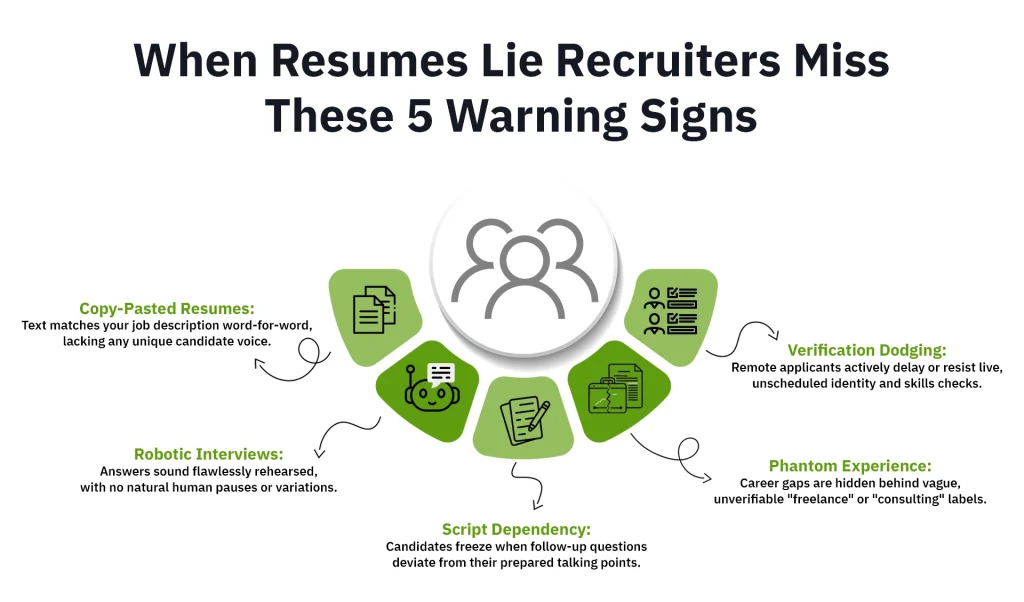
5 Warning Signs Your AI Hiring Stack Is Being Gamed
- Resumes match the job description almost word for word, with zero unique candidate voice or specificity.
- Video interview answers sound rehearsed beyond natural recall, with no genuine hesitation or variation.
- Candidates cannot answer follow-up questions that deviate from the expected script.
- Work history gaps are papered over with vague freelance or consulting roles with no verifiable clients or outputs.
- Remote candidates resist or delay any unscheduled, live identity or skills verification step.
Recruiters Are Losing Trust in Their Own Stack
The crisis is not just between recruiters and candidates. It is inside recruiting teams.
According to SHRM’s 2024 AI in the Workplace survey, only 25% of HR professionals said they fully trusted AI tools to make or recommend hiring decisions. The majority want AI as a support tool only. But business pressure to move fast has not eased. The tools keep scoring fraudsters highly. Recruiters following process keep moving them forward.
Ben Eubanks, HR analyst at Lighthouse Research, has pointed out that recruiting teams are now caught between the mandate to fill roles quickly and a growing gut feeling that what they are seeing is not real. That tension is breaking team confidence from the inside.
The classic approach, stacking a great-looking resume against strong vibes from a video call, was always imperfect. Today it is a liability.
As the evidence behind “Candidate Seems Great” Is Not a Strategy makes clear, “seems great” was never forensic proof. Right now, it is not even a safe starting point.
The Resume Is Broken. Time to Say It Out Loud.
The resume was always a self-reported document. People stretched dates. Titles got inflated. Skills got embellished.
AI did not introduce dishonesty into hiring. It industrialized it.
Every recruiter passing a fraudulent candidate forward is not just making a people mistake.They are potentially lighting six figures on fire. And the real price of a bad hire: a breakdown most companies don’t want to see goes deeper than most finance teams are willing to calculate.
Forensic-level verification cross-references credentials against primary sources. It validates identity, not just a formatted PDF. It confirms that the person who interviewed is the person who shows up on day one.
ATS screening cannot do any of that. It reads text. That is all it does.
Key Takeaways
- AI-generated resumes and real-time AI interview coaching are defeating the very screening tools designed to catch them.
- Documented cases of North Korean IT workers infiltrating U.S. companies using AI-enhanced fake identities are now a federal law enforcement priority.
- Recruiters increasingly report that AI tools are surfacing polished fraudsters ahead of genuine candidates.
- The resume, as a hiring document, is now fundamentally unreliable without independent, forensic-level verification.
- Surface-level ATS screening reads text. It does not verify identity. Those are not the same job.
Final Thoughts
AI did not break recruiting. It exposed weaknesses that were already there.
The industry spent years optimizing for speed. Now it must optimize for truth. Because in 2026, the most dangerous candidate is not the unqualified one. It is the one who looks perfect on paper.
And increasingly, that paper was written by a machine.
The companies that come through this trust crisis will be the ones that treat every hire with the scrutiny they apply to a financial audit. They will verify first. They will trust later.
If your hiring stack cannot tell the difference between a real candidate and a manufactured one, it is time to change that.
Try Octagnt for Free and see what forensic-level candidate verification actually looks like.
Frequently Asked Questions (FAQs)
1. Can recruiters still trust a polished resume at face value?
No. AI generates keyword-perfect resumes in minutes. Recruiters must verify credentials against primary sources, not just read what the document says.
2. Are recruiting teams equipped to detect AI-generated candidate profiles?
No. Most recruiting teams rely on ATS screening, which reads text only. It cannot confirm identity, validate credentials, or catch deepfake profiles.
3. Should staffing agencies be concerned about North Korean operatives applying through their pipelines?
Yes. North Korean IT workers have infiltrated over 300 U.S. companies. Staffing agencies placing remote tech talent are a direct target.
4. Can hiring teams use video interviews to verify a candidate’s real identity?
No. Deepfake video technology makes visual verification unreliable. Hiring teams need forensic identity checks beyond what a video call can confirm.
5. Is a talent acquisition team’s ATS enough to catch resume fraud today?
No. ATS tools match keywords, not truth. Talent acquisition teams need forensic verification layered on top of any automated screening process.
6. Do recruiting teams face legal or security risk from a fraudulent hire?
Yes. A single fraudulent hire can trigger data theft, compliance breaches, and federal investigations. The risk goes far beyond a bad performance review.
7. Should recruitment processes now include identity verification as a standard step?
Yes. Identity verification is no longer optional. Every recruitment process handling remote or tech roles must confirm who the candidate actually is.
8. Can a staffing agency recover its reputation after placing a fraudulent candidate?
Yes. But recovery is slow, expensive, and damaging. Prevention through forensic screening is significantly cheaper than the fallout of a single bad placement.