Candidate Fraud Is Spreading Fast. Could You Prove Your Last Hire Was Even Real?

Candidate Fraud Is Spreading Fast. Could You Prove Your Last Hire Was Even Real?

How did this person get past your initial screen?” The client’s voice crackled over the speakerphone, demanding an immediate answer after their newly hired remote engineer was uncovered as a complete fraud using a stolen identity.

The hiring manager stayed silent. She flipped through her candidate records, realizing with sudden dread that she had zero objective evidence to defend why she advanced the candidate over hundreds of others.

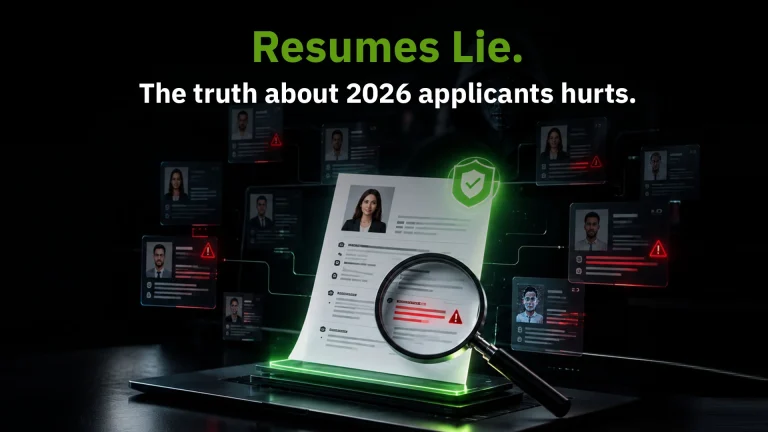
That silence is becoming common across hiring teams in 2026. Resume embellishment used to mean padding a job title or rounding up a GPA on an otherwise ordinary resume. Now it means AI-generated work histories, coached video interviews, and, in the most extreme cases, organized fraud rings placing trained operatives into real companies without anyone noticing. Gartner has projected that by 2028, roughly 1 in 4 job candidates globally could be entirely fabricated, a number that would have sounded absurd five years ago and now reads as conservative. Reporting from the BBC and Forbes has traced North Korean operatives landing remote engineering roles at Western companies, using stolen identities and rehearsed scripts to pass screening that was never built to catch them.

If your team cannot prove why an applicant was accepted or rejected, your hiring workflow is an operational liability. Waiting until the offer stage or background check stage to catch resume misrepresentation is an expensive mistake.

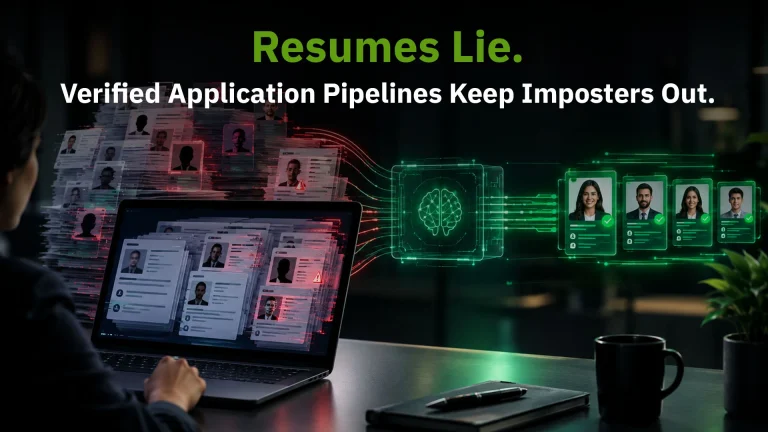
Octagnt stops candidate fraud at the application stage, long before a candidate ever enters a live interview.

Octagnt verifies identity, employment history, and credentials at the application stage, before a resume ever reaches a shortlist. Separately, Octagnt validates skills and claims against how a candidate actually performs, also before the interview stage, not after.

A defensible hiring process does not mean rejecting fewer people. It means having a real, documented answer ready before a client ever calls, backed by evidence instead of a gut feeling nobody wrote down. Hiring managers tired of going silent on a call like that can see what a documented, evidence-based process looks like at octagnt.ai.

Try a Live Role for Free Now

Frequently Asked Questions (FAQs)

What does "no defensible hiring process" actually mean?

It means a company cannot produce clear, objective, and auditable proof explaining why one candidate was selected and why another was rejected. When recruiters rely on subjective notes or unverified resume claims, the hiring pipeline becomes a legal and operational liability.

Why do resumes lie so frequently in the AI era?

Generative AI tools allow applicants to manufacture tailored work histories, inflate achievements, and pass keyword filters instantly. Resume embellishment and resume misrepresentation have scaled massively, making traditional resumes completely unreliable as a sole source of candidate truth.

Why does candidate evaluation need to happen at the application stage specifically?

Waiting until the interview or background check stage wastes hundreds of team hours on fake or unqualified candidates. Catching candidate fraud and resume misrepresentation at the application stage, before a live interview, keeps fake profiles out of your workflow entirely.

What should recruiters start doing differently right now to build a defensible process?

Recruiters must stop trusting unverified resume claims and move away from subjective initial screens. They should implement objective application-stage checks that verify identity and validate skills upfront, ensuring every single advancement or rejection is backed by defensible data.
Share this article

← Back to all articles

Ron Maitra

Ron Maitra is the CEO and Founder of Octagnt.ai. He writes about the hard problems in hiring — resume fraud, deepfake interviews, AI's erosion of trust, and what verification-first recruiting looks like as a fix.

LinkedIn