
“He seems like a great fit.”
“She has a really high energy.”
“They just ‘get’ our culture.”
If your recruiting team relies on these phrases, you aren’t hiring. You are gambling. In the current job market, “vibes” are a liability. We are living through a massive trust crisis. Between AI-generated resumes that bypass filters and sophisticated fake profiles, the “great candidate” in front of you might be a hallucination.
Relying on gut feel in 2026 is like trying to navigate a ship through a fog bank without radar. You might make it to shore. You might also hit an iceberg.
The Death of the "Good Feeling
We used to value the “airport test.” This was the idea of asking if you would mind being stuck in an airport with a candidate. It was a charming metric for a simpler time. Today, that test is useless.
According to recent Gartner research, nearly 50% of candidates admit to using generative AI to “enhance” their resumes or cover letters. This goes beyond fixing a typo. Candidates use AI to mirror the exact keywords of your job description. They create a perfect digital twin of the person you want to hire.
When they show up for the interview, they are coached by bots on what to say. They provide the “right” answers, not the true ones. If your strategy is just a “good feeling,” you are likely falling for a well-engineered script.
The Rise of the "Ghost" Candidate
The BBC recently highlighted a disturbing trend in the tech sector: professional “interviewers for hire.” In these scenarios, a highly skilled proxy performs the technical interview via video call. Once the offer is signed, a completely different person shows up for the first day of work.
This isn’t a plot from a spy movie. It is happening in firms every week. When your recruiting team says a candidate “seems great,” they might be looking at a professional actor.
Without forensic proof, you aren’t just hiring a bad employee. You are inviting a security risk into your ecosystem.
Industry analyst Josh Bersin has written extensively about the shift from “systems of engagement” to “systems of productivity,” making the case that HR technology must make employees’ work lives measurably better, not just log activity. Applied to recruiting, that distinction matters enormously. An ATS that captures résumés without capturing the reasoning behind every decision is a system of record that does nothing to improve the quality of who actually gets hired. It stores data. It does not generate proof.
As Bersin has noted, most companies have eleven or more systems of record for HR, and the biggest challenge is not a shortage of data. It is integrating and cleaning that data into something that actually drives decisions.
This is where evidence-based hiring becomes not just a best practice but a competitive advantage.
The Trust Layer of ATS: Every Hire Needs a "Why"
Your Applicant Tracking System (ATS) is a gold mine of data. Most teams use it as a digital filing cabinet. This is a mistake.
The ATS should be your Trust Layer. Every move a candidate makes through the pipeline must have a ‘Why’ attached to it. For a hire to be truly defensible, your shortlist must be fast, verified, and reasoned: a standard that transforms your database into a source of truth.
✅ | Why did they pass the technical screen? (Show the raw code or the recorded logic). |
✅ | Why do we believe their past experience is real? (Provide the back-channel reference check). |
✅ | Why did they choose this specific role? (Evidence of intent over a generic application). |
Forbes often notes that the most successful companies treat recruiting like a forensic investigation. They don’t look for reasons to hire. They look for reasons to disqualify. If a candidate survives that scrutiny, the “Why” becomes clear.
Octagnt: The Truth-to-Hire Infrastructure
This is where Octagnt changes the game. While traditional systems just track a candidate’s journey, Octagnt builds a “Truth-to-Hire” infrastructure. It acts as the forensic lens your recruiting team is currently missing.
Octagnt solves the trust crisis by shifting the focus from claims to verification. It verifies and validates candidate skills and identities in real-time. Instead of a recruiter saying, “I think they know Python,” Octagnt allows the team to say, “We have verified proof of their logic and identity.”
It is the missing piece of the puzzle. By integrating forensic-level verification into the early stages of the funnel, Octagnt ensures that your “Trust Layer” isn’t just a buzzword. It is a documented reality. In a world of AI noise, Octagnt is the signal.
5 Pillars of the Forensic Hiring Framework
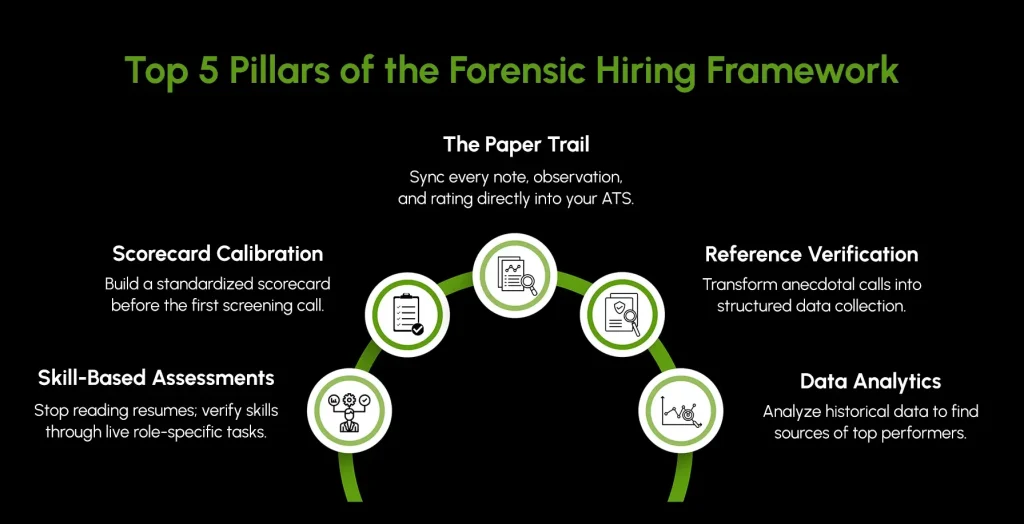
Moving from a gut feeling to a data-driven decision requires a standardized process that treats every interview like an investigation. The following framework provides the visual roadmap your team needs to transition from “vibes” to forensic proof.
- Skill-Based Assessments: Move past the résumé. Verified performance matters more than listed credentials. Whether through structured work samples, cognitive assessments, or role-specific tasks, every candidate needs to demonstrate the skill, not just claim it.
- Scorecard Calibration: Every interviewer must measure the same criteria. A scorecard built before the first screening call ensures that “strong communicator” means the same thing to the engineering manager as it does to the HR partner. Calibration eliminates the single most common source of panel disagreement: everyone is measuring something different.
- The Paper Trail: Detailed interview notes, synced directly to the ATS, close the loop between what was observed and what was decided. If the notes live in a personal inbox or a Slack DM, the Trust Layer is broken. Centralizing forensic proof in one system means every hire is defensible to stakeholders, auditors, and future search teams.
- Reference Verification: References are not a formality. They are qualitative data. Turning anecdotal reference calls into structured conversations, with consistent questions and documented responses, transforms the weakest part of most hiring processes into actual evidence.
- Data Analytics: Historical hire data is the most underused asset in recruiting. Which source channels produce the highest-performing year-one employees? Which competency scores predict long-term retention? Using that data to justify current selections moves recruiting from reactive to proactive.
Why Your Reputation Depends on This
In an era of deepfakes and automated applications, a recruiter who can find the truth is worth their weight in gold. Hiring managers are tired of the “candidate seems great” line. They want to hear, “This candidate is the real deal, and here is the data to prove it.”
When you provide forensic proof, you build an unbreakable bond of trust with your hiring managers. You become a strategic partner instead of a resume pusher.
Key Takeaways
- A “good feeling” in hiring is not a data point. It is a bias.
- Assume every resume is “optimized” until proven otherwise.
- The ATS is an evidence locker. Use your tools to store proof, not just contact info.
- Octagnt verifies reality. Use specialized platforms to ensure “Truth-to-Hire” early on.
- Bad hire based on a “great personality” destroys the trust of your existing team.
Conclusion
Recruiting is the most important function in any company. You are the gatekeepers of the culture and the bottom line. Stop settling for “great.” Start looking for “proven.”
When you move from a strategy of feelings to a strategy of forensic proof, everyone wins. The company gets better talent. The team stays productive. And your reputation as a recruiter becomes bulletproof.
The next time someone tells you a candidate “seems great,” ask them one simple question: “Where is the proof?”
Run your toughest requisition through Octagnt for free
Frequently Asked Questions (FAQs)
-
Does the recruiting team need to document every “no” as thoroughly as every “yes”?
Yes. The reasons for rejection provide the calibration data needed to sharpen future searches. If an agency or internal recruiter cannot explain why a candidate was passed over using objective metrics, the pipeline is leaking intelligence.
-
Do leading HR analysts support moving away from gut-feel hiring?
Yes. Josh Bersin consistently emphasizes that companies need to eliminate irrelevant decision factors and focus on real skills and job performance data, treating what seems qualitative as something AI and analytics can make quantitative.
-
Will forensic proof slow down time-to-hire?
No. It accelerates the final decision stage. The delays in most hiring processes happen at the committee level, when people are “not quite sure.” A complete evidence dossier eliminates that hesitation.
-
Is the financial cost of a bad hire significant enough to justify this level of scrutiny?
Yes. Industry research consistently puts total bad-hire costs at up to $240,000 per person when the full chain of lost productivity, cultural damage, and re-hiring expenses is counted. That number justifies a great deal of rigor upfront.
-
Does Octagnt provide real-time candidate validation?
Yes. Octagnt integrates forensic verification into the funnel to validate skills and identities, replacing claims with verified proof.
-
Can AI-generated resumes bypass standard ATS filters?
Yes. Candidates use generative AI to mirror keywords perfectly, creating “digital twins” that look ideal but may lack actual skills.
-
Is historical hiring data useful for current requisitions?
Yes. Data analytics help recruiting teams identify which channels and competency scores actually lead to high-performing, long-term hires.