

A bad hire rarely walks out alone.
It leaves behind missed deadlines, frustrated teams, burned-out recruiters, damaged client trust, and a recruiting function forced into defensive mode. What starts as one hiring mistake quickly turns into operational chaos that spreads across departments.
The fallout is rarely immediate. It builds quietly.
A hiring manager starts questioning every shortlist. Recruiters spend weeks refilling the same role. Top performers grow resentful covering for underperformance. Clients begin asking harder questions. Leadership starts losing confidence in the hiring process itself.
Then suddenly, one hiring mistake becomes everyone’s problem.
For staffing firms and recruiting leaders, the damage cuts even deeper. Every failed placement chips away at credibility. Every poorly vetted candidate creates another layer of skepticism between recruiters and clients.
And in 2026, the risks are escalating fast.
AI-generated resumes (Link Hiring Pain Main Blog once it is published), interview coaching tools, and increasingly sophisticated candidate manipulation have made hiring more deceptive than ever before. Candidates can now look exceptional on paper while hiding major gaps in capability, experience, or authenticity.
The real question is no longer whether companies can afford better hiring practices.
It is whether recruiting teams can survive another bad hire.
The Real Price of a Bad Hire Goes Far Beyond Salary
Most executives still underestimate the true cost of hiring mistakes.
The assumption is simple: replace the employee, absorb the loss, and move on.
But the numbers tell a different story.
According to SHRM’s 2025 Benchmarking Report, the average cost per hire in the United States has risen sharply in recent years, with executive hiring costs reaching tens of thousands of dollars before onboarding even begins.
That is only the starting point.
The U.S. Department of Labor estimates that a bad hire costs at least 30% of the employee’s first-year earnings in direct losses alone. Meanwhile, the Toggl Hire 2025 Report found that indirect losses tied to bad hires can range anywhere from $30,000 to well over $150,000 once productivity loss, re-hiring costs, delayed projects, and operational disruption are included.
And the issue is becoming increasingly common.
The same report found that nearly one in four companies experiences multiple bad hires every year.
For staffing agencies and recruiting firms, those losses are magnified because the damage impacts multiple layers simultaneously:
- recruiter credibility
- client confidence
- internal morale
- revenue continuity
- long-term business reputation
Why Bad Hires Are Becoming More Common in 2026
Hiring has fundamentally changed over the last two years. AI has not created hiring problems. It has amplified them at scale.
Candidates now have access to tools that can:
- optimize resumes instantly
- generate polished interview responses
- mimic technical expertise
- create highly convincing professional narratives
A candidate may appear confident, technically sound, and culturally aligned during interviews while masking serious performance gaps underneath.
When Bad Hires Turn Into Internal Finger-Pointing
This is the part most organizations never discuss openly. A failed hire almost always creates internal blame cycles.
Hiring managers question recruiter judgment. Recruiters blame rushed timelines and unrealistic expectations.
Leadership starts scrutinizing talent acquisition strategy. Departments lose confidence in one another.
Eventually, every future hiring decision becomes slower, more political, and more defensive. Instead of collaboration, recruiting teams operate under pressure to justify every shortlist and defend every recommendation.
That kind of environment destroys hiring momentum.
And for staffing firms, the consequences are even more severe because failed placements directly affect client retention and repeat business.
One Bad Hire Can Destabilize an Entire Recruiting Function
Consider a common scenario playing out across recruiting firms in 2026.
A staffing agency spends six weeks filling a senior engineering role for a high-value client. The candidate interviews flawlessly, presents an impressive resume, and clears every traditional screening step.
Within 90 days:
- project delivery begins slipping
- internal complaints start surfacing
- team productivity declines
- the client loses confidence in the placement
Top 5 Ways a Bad Hire Destroys Your Recruiting Team From the Inside Out
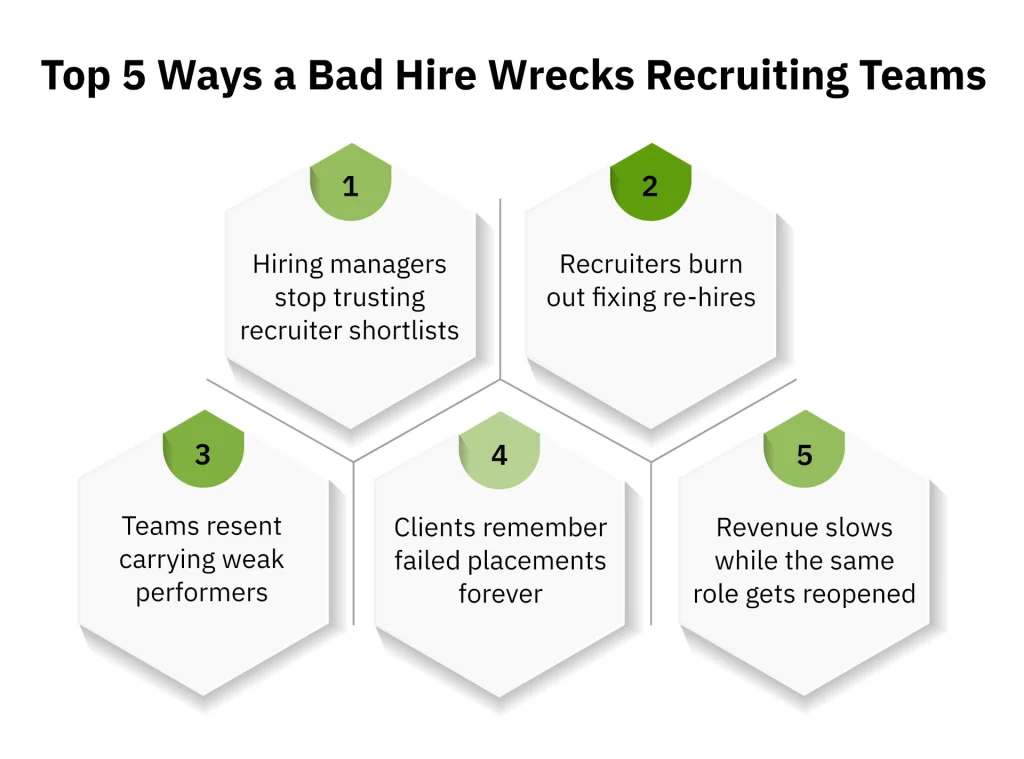
Understanding where the damage happens helps recruiting leaders stop the fallout before it spreads further.
1. Credibility Erosion With Hiring Managers
Every failed hire weakens recruiter trust.
Hiring managers begin second-guessing recommendations, expanding searches externally, and questioning shortlist quality. Rebuilding that confidence can take months.
2. Recruiter Burnout and Attrition
Bad hires create rework. Rework creates overload.
And overload eventually burns out recruiting teams already operating under aggressive hiring pressure. The best recruiters are often the first to leave when hiring chaos becomes constant.
3. Cascading Team Disengagement
One poor performer forces stronger employees to compensate.
Resentment builds quickly. Collaboration weakens. Productivity slows. Gallup’s recent workforce findings continue to show that disengaged teams create enormous financial and operational losses globally.
4. Damaged Client and Candidate Relationships
For staffing firms, one failed placement can permanently damage client trust.
Clients remember hiring failures longer than successful placements. Candidate confidence also declines when organizations develop reputations for unstable hiring decisions or poor role alignment.
5. Longer Time-to-Fill and Revenue Loss
A bad hire creates two productivity gaps:
- the period where the wrong person occupies the role
- the second hiring cycle required after they leave
That delay impacts delivery timelines, sales performance, and overall business momentum.
Why Traditional Hiring Signals No Longer Work
Resumes are no longer reliable indicators of capability. Neither are polished interviews.
Modern hiring risk comes from overreliance on presentation instead of verification.
That is why many recruiting leaders are moving toward forensic hiring approaches designed to validate reasoning ability, expertise, and authenticity before hiring decisions are finalized. The focus is shifting from “Who interviewed well?” to “Who can actually perform under real-world conditions?”
The Future of Recruiting Belongs to Teams That Reduce Decision Risk
Speed still matters in recruiting. But defensibility matters more.
Clients no longer want resume volume alone. They want confidence in the decision itself. They want proof that the candidate being hired can actually perform, deliver, and integrate successfully.
That means recruiting teams must evolve beyond resume processing. The firms that win in the next decade will not necessarily be the ones that hire fastest.
They will be the ones that make the fewest hiring mistakes.
Key Takeaways
- A bad hire impacts far more than salary costs. It damages recruiter credibility, client trust, productivity, and team morale.
- AI-generated resumes and interview coaching tools are making hiring deception harder for recruiting teams to detect.
- Staffing agencies and recruiting firms face amplified risks because one failed placement can affect long-term client relationships and future revenue.
- Traditional hiring signals like resumes and polished interviews are no longer enough to reduce hiring risk effectively.
- Verification-first hiring approaches help recruiting teams make faster, more defensible hiring decisions while minimizing costly re-hiring cycles.
Final Thoughts
One bad hire used to be recoverable.
In today’s recruiting environment, it can destabilize an entire hiring function.
The damage spreads across recruiters, hiring managers, clients, team morale, productivity, and long-term business reputation. And with AI making candidate presentation increasingly sophisticated, the traditional recruiting playbook is no longer enough to protect organizations from costly hiring failures.
The toxic fallout of a bad hire is no longer temporary.
It compounds.
And the recruiting teams that survive the next era of hiring will be the ones that stop treating hiring decisions like assumptions — and start treating them like risks that must be verified before the damage begins.
The question is no longer whether verification-first hiring matters.
The question is how much another hiring mistake will cost before the process changes.
Ready to reduce hiring risk before it impacts your team, clients, and reputation?
Frequently Asked Questions (FAQs)
1. Can bad hires impact recruiting team performance?
Yes. AI tools help candidates optimize resumes and interview responses, making it harder for recruiters to accurately assess real skills and experience.
4. Can hiring managers lose trust in recruiting teams after failed hires?
Yes. Repeated hiring mistakes can make hiring managers question recruiter recommendations, slowing decision-making and increasing hiring friction across teams.
5. Do bad hires increase time-to-fill for staffing agencies?
Yes. Failed placements create additional hiring cycles, delay project delivery, and significantly increase time-to-fill for recruiting and staffing teams.
6. Can verification-first hiring reduce hiring mistakes?
Yes. Verification-first hiring helps recruiters validate candidate skills, reasoning ability, and authenticity before making hiring decisions.
7. Do recruiting teams need better candidate verification in 2026?
Yes. AI-enhanced candidate presentation has increased hiring risks, making stronger verification processes essential for modern recruiting teams.
8. Can a bad hire affect company culture and employee morale?
Yes. Bad hires often create disengagement, productivity loss, internal conflict, and additional pressure on high-performing employees and managers.